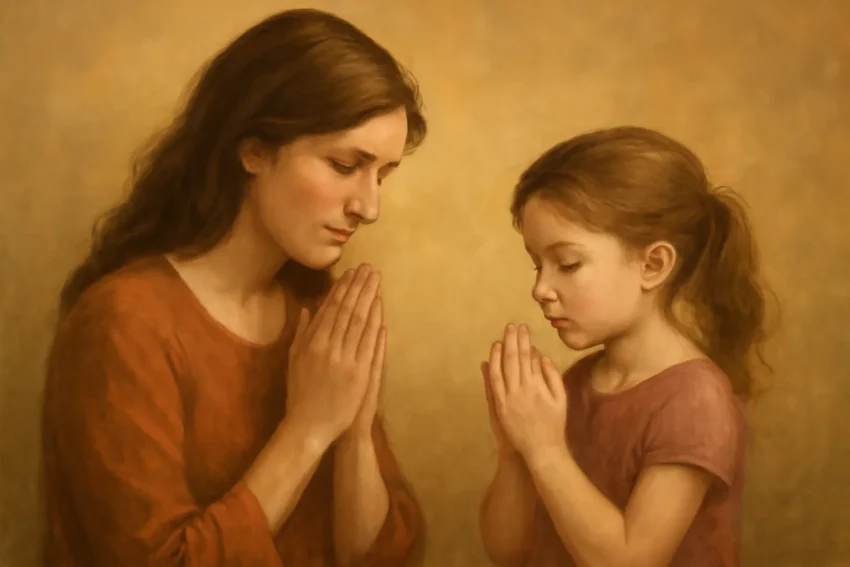
A Prayer for My Daughter Poem: Heartfelt Verse for Hope, Strength, and Protection offers a window into how poetry can shelter love and guide a child through a world that is at once beautiful and fragile. This article surveys the lineage of the parental prayer in poetry, uses the famous poem commonly titled A Prayer for My Daughter as a touchstone, and then provides fresh, original variations that expand the idea into new voices, rhythms, and sensibilities. Whether you are a parent seeking words for your own daughter or a reader exploring the ethics of care, the language of a prayer can become a practical instrument for daily life, memory, and inspiration.
The phrase “A Prayer for My Daughter” is inseparable from the work of the Irish poet W. B. Yeats, whose life bridged the intimate circle of family and the vast questions of national identity, history, and myth. Composed in a period of upheaval—postwar turbulence, political tumult, and social change—the poem turns a protective gaze toward a newborn daughter, offering a prayer that her life be guided by grace, dignity, and moral steadiness. While the world around her may be stormy, the speaker seeks to create a harbor of gentleness and courage within her, a reserve of inner strength that can weather difficulty without sacrificing compassion.
Analytically, the poem is often read as a lyrical blend of intimate fatherly voice and universal aspiration. The speaker’s concerns move from the immediate safety and happiness of a child to broader ethical concerns: what kinds of beauty, order, and restraint should guide a life? By weaving natural imagery with an almost liturgical cadence, Yeats situates the private scene of a parent’s bedrock hope within the larger, impersonal forces of history, time, and fate. This fusion—between private devotion and public virtue—gives the poem its enduring power and its aura of timelessness.
In the decades since its creation, readers have found that the poem’s core questions remain urgent: How can we protect the vulnerable without overbearing them? How do we nurture a child’s own agency while offering a moral compass? These questions are not tied to a particular era; they recur in countless forms as new generations grow. For many, the poem becomes a template for personal prayer—an invocation that can be adapted in countless voices, languages, and contexts. The idea of a parental prayer for a daughter—whether in Yeats’s era or our own—transforms into a living practice: a daily reminder to cultivate hope, strength, and protection in the world the daughter will inherit.
In conversations about the poem and its heir, three interwoven motifs stand out as the scaffolding of meaning. Each theme functions as both a descriptive image and a moral instruction, shaping how a reader might read the poem, or how a parent might write a new prayer for a daughter.
Hope as forward-looking confidence: The prayer asks not only for safety in the present but the emergence of a future in which the daughter can flourish with purpose and joy.
Strength as resilience and moral clarity: Strength here is not brute force but the steadiness to make wise choices, to endure hardships, and to remain true to one’s values in the face of fear or pressure.
Protection as guardianship and restraint: Protection is both a shield against harm and a discipline that helps the daughter grow into self-possession, autonomy, and responsibility.
Grace and dignity as inner goods: The poem often reveres qualities that elevate character—gentleness that does not shy from truth, beauty that does not blink at responsibility, mercy that does not dissolve ethical boundaries.
Wisdom as the compass for living well: The prayer invites a life guided by discernment, empathy, and a sense of the common good.
Viewed together, these themes create a framework for both interpretation and creation. A reader may approach the original poem for its musical cadence and symbolic imagery, while a writer may adopt its spirit to compose new prayers for daughters in varied voices—fatherly, maternal, grandparental, or contemporary. The outcome is a living tradition: poetry that protects while it invites growth, that consoles while it challenges, and that anchors hope while opening space for a daughter’s own voice to emerge.
Variations of a Prayer for My Daughter: fresh voices and forms
The following variations honor the core idea of a protective, hopeful, and ethically oriented prayer for a daughter, but they are original compositions or adaptations written to reflect different perspectives, ages, and moments. Each piece is designed to be readable as a short poem or as a compact section within a larger prayer, and each one foregrounds hope, strength, and protection in its own way.
Variation 1: The Father’s Quiet Morning Prayer
O daughter of the dawn, I ask the morning to keep you safe and brave,
to cradle your heart with gentleness and truth,
to teach your steps to walk in honor and care.
May your days be lined with courage like light on the sea,
and may you meet the world with a steadiness that never tires of kindness.
Variation 2: The Mother’s Prayer for Her Daughter
Daughter, you carry a world of questions and a heart full of compassion—
may your memory be a map of justice and your voice a bell for the weak.
Let me be your shelter and your compass, a place where dignity and curiosity meet;
may your mornings rise with hope and your nights soften with grace.
Variation 3: The Grandparent’s Light-Hearted Guiding Prayer
Little one, we keep a garden of stories for you to wander through—
in every corner a lesson in kindness, every thorn a chance to sharpen wisdom.
May your sweetness be a shield and your laughter a lantern in the dark,
and when you trip, may you rise with courage and a gentler ear for others.
Variation 4: A Modern Parent’s Practical Prayer
In a world of screens and storms, may you find balance,
may your curiosity lead to learning,
may your voice be heard with respect and your empathy be your guide.
Protect your body and your dreams, and always remember your worth.
How to read and respond to a prayer-poem for a daughter
Approaches to close reading
Notice how imagery is used to bridge the intimate and the universal.
Pay attention to repetition or motif: repeated words or lines that emphasize core values such as hope, strength, and protection.
Reflective prompts for readers and writers
What kind of moral compass would you want to offer to a daughter in today’s world?
Which images or scenes in a prayer-poem resonate most deeply for you, and why?
What values do you want to foreground—justice, empathy, courage, or curiosity? How would you weave them into verse?
How can a prayer-poem serve as a daily practice rather than a one-time sentiment?
How to write your own “Prayer for My Daughter” poem: practical steps
Define intention: Decide the core promises you want to make for your daughter—safety, education, kindness, resilience, equality, etc.
Choose a voice: Will the poem be spoken by a father, mother, grandparent, or a community voice? Each voice brings different textures.
Gather sensory imagery: Look for images from dawn to night, sea and shore, weather, birds, or familiar home spaces. Sensory detail strongens the prayer’s immediacy.
Balance personalization and universality: A personal memory can illuminate universal values, creating a prayer that feels intimate and widely relevant.
Layer tone: Mix tenderness with resolve. A prayer can cradle comfort while demanding courage.
Use repetition with care: A few refrains can anchor the reader, but overuse can flatten energy. Let repetition emphasize core themes like hope, strength, and protection.
Shape and form: Decide on stanzas, lines, or a free-verse flow. A simple form can carry a profound message; a more intricate cadence can echo liturgical or ceremonial speech.
Revise with intention: Read aloud, listen for rhythm, and adjust diction to ensure the prayer remains accessible, dignified, and heartfelt.
To illustrate, consider this brief template you can adapt:
O daughter of the dawn, may your days be filled with hope, and your steps guided by grace.
Let your heart be strong, yet gentle toward others, and your voice speak for those who cannot speak for themselves.
Shield you from harm, ground you in kindness, and embolden you to pursue truth with courage.
Practical uses: bringing the prayer into daily life
Recite a line or two each morning as part of a family ritual, turning the prayer into a living habit rather than a one-time aspiration.
Use the prayer as a lullaby or bedtime benediction, transforming nightly moments into a ritual of safety and care.
Turn the prayer into a journal prompt: write a short reflection daily or weekly that aligns with the prayer’s themes.
Gift a handwritten version of the prayer or a personal variation to your daughter on a significant occasion, widening the circle of meaning and memory.
Share a version of the prayer with a partner or family member to deepen shared commitments to your child’s wellbeing.
Beyond personal use, the idea of a parent’s prayer can inform education, mentoring, and community life. Schools, libraries, and community centers occasionally host writing circles where participants draft their own prayers for younger generations, exploring how language can comfort, inspire, and mobilize ethical action. The practice blends literary craft with everyday ethics, making poetry a tool for care rather than a distant art object.
Further reading and reflection
Yeats, W. B. A Prayer for My Daughter—the original text (public-domain editions available in many libraries and online archives). Reading the poem can illuminate how private longing becomes public virtue.
Critical essays on Yeats and The Tower: exploring the ways the collection engages with memory, politics, and spiritual longing.
Modern prayers and poems for daughters: several contemporary poets offer fresh voices that engage with the same core questions—protective love, moral formation, and hopeful futures.
Creative-writing handbooks on writing devotional or ceremonial poetry, which provide practical advice for shaping a personal prayer into a enduring literary form.
Closing reflections
Whether one reads the original poem as a father’s wish for hope, strength, and protection for a newborn daughter, or encounters a modern variation that speaks from a different life stage, the core idea remains vibrant: poetry can be a means of care, a vow to protect, and a guide toward virtue. A prayer for my daughter—in any voice or form—maps a path from intimate love to broad implication. It acknowledges risk and fear while insisting on possibility. It honors the daughter’s personhood and her future, while inviting the parent to grow alongside her. In this sense, the prayer is not a guarantee but a practice—of attention, presence, and daily recommitment to the best that a family and a community can offer.
As readers, we can carry forward Yeats’s impulse by cultivating our own hope, strength, and protection for the people we love. The variations above are invitations to try new voices, new rhythms, and new images—yet all stay anchored in the same essential duty: to bless a daughter with a life worthy of her humanity, and to live in a way that makes that life more possible for her and for others.