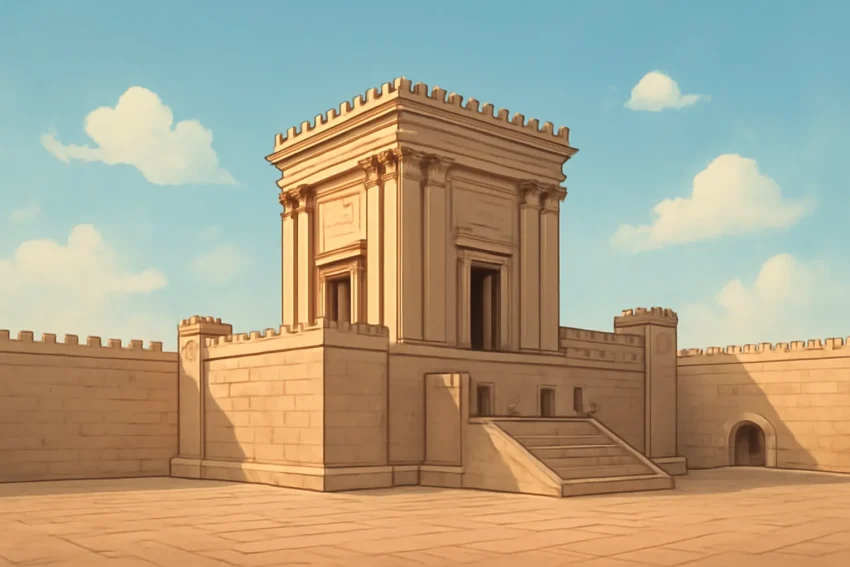
The idea of a Third Temple in Jerusalem sits at the intersection of history, theology, and politics. For some, the term denotes a literal rebuilding in the future that would reestablish sacrificial worship and divine presence on the site traditionally associated with the Beit HaMikdash (the Holy Temple). For others, it serves as a profound symbol—an eschatological hope, a spiritual ideal, or a focal point for religious longing that has transcended generations. This article offers an expansive look at the Third Jerusalem Temple as a historical concept, its religious and cultural significance, and the diverse visions people hold for its future prospects.
The phrase Third Temple is used differently across communities. In classical Jewish texts, it refers to a future sanctuary that would stand on the Temple Mount and restore the sacrificial system described in the Torah and later rabbinic writings. In modern discourse, it can also denote a political or religious project, a literary motif, or a symbolic aspiration for renewed reverence in Jerusalem. Across centuries, the idea has evolved, absorbed new meanings, and sometimes moved from a strictly liturgical construct to a broader cultural and ethical aspiration. In this sense, the Beit HaMikdash shelishi—the third Beit HaMikdash—is not a single static plan but a spectrum of beliefs about how divine presence, worship, and national memory would be realized in the city most sacred to Judaism, and to Islam as well, due to its location on the Temple Mount.
History
Ancient roots and the First Temple
Long before the modern era, the Jewish people remembered and retold the story of the First Temple. Built by King Solomon in the 10th century BCE, the First Temple stood as the central sanctuary for the sacred service of the Jewish people. Its destruction in 586 BCE by the Babylonians marked a profound turning point in Jewish history and the beginning of a long period of exile and longing. The memory of that temple—its architecture, its ritual life, and its sacred spaces—became a benchmark for what many hoped would be regained or renewed in the future. In this sense, the term Third Temple is connected to a continuity of longing that traversed centuries and survived diaspora, ritual, and theological reflection.
The Second Temple era and Herod’s expansion
After the return from exile, the Jewish community rebuilt the Second Temple around 516 BCE. It became the center of Jewish worship and the focal point of annual pilgrimage festivals. In the first century BCE and into the early first century CE, Herod the Great undertook a monumental expansion and renovation of this sanctuary. The result was a grander, more monumental complex that scholars describe as a major achievement of ancient architecture and religious life. The Second Temple stood for several centuries, hosting the priestly service, the mikveh rituals, and the festival processions that connected people to the divine presence. Yet in 70 CE, after a brutal siege, the Romans destroyed the temple, leaving only the Western Wall as a remaining remnant for prayer and reflection. This destruction did not erase Jewish longing for a future sanctuary; rather, it intensified debates about the nature of worship, the correct site for sacrifice, and the meaning of divine covenant in their time.
Diaspora, liturgy, and the enduring hope
With the Temple no longer standing, the Jewish people carried forward a vibrant tradition of longing, prayer, and landscape of memory. The idea of a future sanctuary persisted in rabbinic literature, liturgy, and later messianic expectation. In Jewish prayers, the desire to return to Zion and to rebuild the sanctuary appears in devotions that celebrate the restoration of the days of old. Even as communities dispersed across the Mediterranean and beyond, the memory of the Holy Temple remained a common thread that linked generations. The concept of a Third Jerusalem Temple thus grew not only as a physical plan but also as a spiritual horizon, a standard by which Jews assessed the harmony between divine promise and human history. The synagogues, schools, and communities that formed in exile often used temple-centered language to articulate ethical commitments, social justice, and the aspiration for peace in the land of their ancestors.
Significance
Religious significance
In traditional Judaism, the anticipated construction of a Third Temple is tied to a messianic age when divine presence would once again dwell among the people. Views diverge on what form such a temple would take and whether sacrifices would resume. For many Orthodox and some traditionalist circles, a literal building in Jerusalem could reintroduce a restored temple service, including offerings conducted by a hereditary priesthood and unique ritual rites. Others emphasize a spiritual or symbolic temple—an inner, ethical, and communal restoration that does not necessarily require a physical rebuilding or a full sacrificial system. These positions reflect a spectrum from a future, tangible sanctuary to a figurative restoration of covenantal identity wrapped in acts of justice, prayer, and study. Across the religious landscape, the term Third Temple often functions as a lens to discuss holiness, repentance, and the responsibilities of a people toward their God and their neighbor.
Historical and cultural significance
The prospect of the third temple movement or similar ideas has had a powerful cultural impact. It has shaped architectural imaginations, liturgical reforms, and even contemporary art and literature. The city of Jerusalem itself embodies a deep layer of memory in three great traditions—Judaism, Christianity, and Islam—each of which holds sacred elements related to the Temple complex and its surrounding spaces. The cultural memory of the Beit HaMikdash shelishi informs debates about heritage preservation, archaeology, and the responsibilities of cultural stewardship in a contested urban landscape. Even among secular historians, the temple’s history informs conscientious reflection about power, sacred space, and the way communities negotiate religious identity within a multifaceted city.
Contemporary political and social dimensions
In the present era, discussions about the possibility of a Jerusalem third temple intersect with political realities surrounding the Temple Mount or the Haram al-Sharif complex. Accessibility, sovereignty, security, and international diplomacy all shape what is and is not feasible in the near term. For some, the very idea raises questions about freedom of worship, religious pluralism, and the risk of intercommunal tension. For others, the topic remains a matter of sacred obligation and a potential catalyst for moral renewal. The dialogue around a possible Third Temple is thus inseparable from debates about the future of a divided but interwoven city, where sacred space intersects with daily life, education, tourism, and civic governance.
Future Prospects
Religious perspectives on a Third Jerusalem Temple
Within Jewish thought, there is no single, universally accepted blueprint for a future sanctuary in Jerusalem. Some streams anticipate a literal restoration of the temple precinct with a functioning priesthood, sacrificial rites, and a new architectural program. Other voices argue for a symbolic temple—a reformulated, non-sacrificial service based on prayer and Torah study, emphasizing universal access, peace, and repentance as a substitute for ritual offerings. The diversity of opinion includes:
Literal restoration proponents who envision a rebuilt sanctuary that mirrors biblical descriptions and includes a functioning priesthood.
Spiritual-theological advocates who frame the Third Temple as an inner transformation—an ethical, devotional, and communal renewal that fulfills the covenant without physically reconstructing a sanctuary.
Ecumenical and interfaith perspectives that see the temple project, if realized, as a moment for shared responsibility, open dialogue, and moral leadership, rather than exclusive claim-making.
Practical and political considerations
Any discussion of a Third Temple must reckon with the realities of governance, sovereignty, and security in a city that has been at the center of regional and global affairs for millennia. Important factors include:
The delicate status quo surrounding the Temple Mount and adjacent religious institutions, which is a central pillar in regional stability and international diplomacy.
The potential implications for religious freedom and access to holy sites for Jews, Muslims, and Christians alike.
The risk of escalation or conflict if proposals for rebuilding or structural changes are pursued without broad consensus and robust safeguards.
The compatibility of any architectural project with archaeological preservation, heritage law, and the needs of a modern, diverse city.
Alternative visions and messianic expectations
Across traditions, the end of days expectations often intersect with the concept of a Third Temple, yet interpretations differ. Some view the prophetic timetable as pointing toward a future era when peace is established and all nations come to recognize a single divine sovereignty. Others caution against conflating religious longing with political programs that could inflame tensions on the ground. In many communities, the longing for a future sanctuary coexists with commitments to social justice, mutual respect, and the protection of human rights as an ethical prerequisite to holy action. Still others emphasize ongoing Jewish liturgical rhythms—the daily prayers, the Sabbath, and festivals—where the memory of the temple helps to shape daily conduct and communal ethics without requiring immediate political action on a site that is contested by multiple faiths.
Conclusion: A Complex, Contested Horizon
The prospect of a Third Temple in Jerusalem encompasses more than a single architectural project. It anchors a web of theological hopes, historical memory, cultural identity, and political reality. For scholars, theologians, and lay readers alike, the topic invites careful attention to textual sources, archaeological findings, and the lived experiences of communities who regard the Temple as a living symbol—one that has inspired rituals, informed ethics, and provoked debate for generations. The Jerusalem’s third Beit HaMikdash—whether understood as a literal future sanctuary, a symbolic renewal, or a combination of both—elicits questions about what it means to live with sacred history in a contemporary metropolis. As such, it remains a subject of ongoing study, discussion, and reflection, where history and faith meet at the crossroads of a city that has been and continues to be a hinge of memory for the Jewish people, a focal point for global Islam, and a crossroads for Christian tradition as well.
To engage thoughtfully with this topic, one can explore primary sources such as biblical narratives and rabbinic literature, as well as modern scholarship on archaeology, religious studies, and Middle East politics. The discourse around the Third Temple in Jerusalem is not merely about architecture or ritual practice; it is a question about identity, memory, responsibility, and the moral imagination of a people and their neighbors in a city that many consider sacred beyond description. Whether the future holds a literal rebuilding or a renewed sense of sacred presence in daily life, the discussion itself illuminates how a people remembers its past, interprets its present, and hopes for the future in a city that has long stood at the heart of world history.
If you are exploring this topic for study or journalism, consider the following guiding ideas:
Understand the historical chronology of the First and Second Temples, their destructions, and the long period of Diaspora.
Differentiate between religious metaphors and practical political realities in contemporary discussions.
Be mindful of the interfaith context in which any dialogue about sacred space occurs, especially on a site that two major world religions hold sacred.