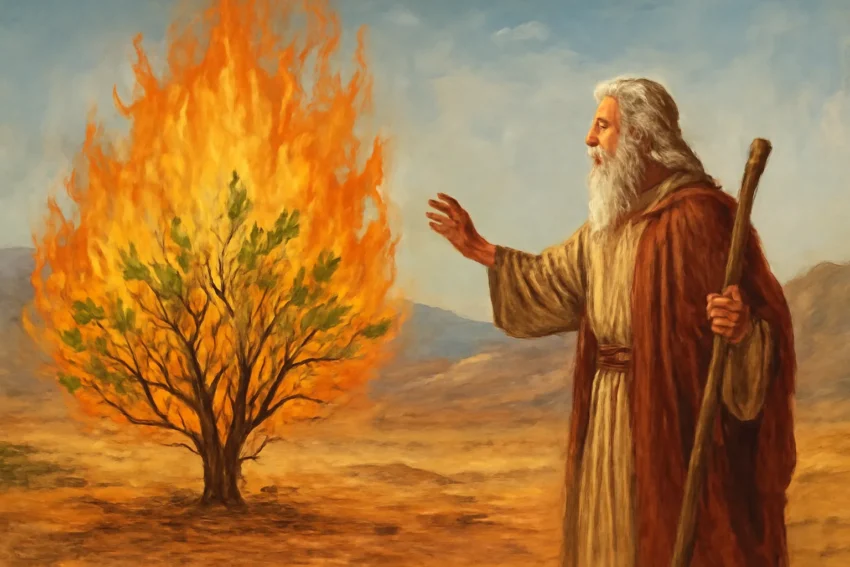
Burning Bush and Moses: The Biblical Encounter Explained
The story of the burning bush and the prophet Moses stands at a crossroads of revelation, leadership, and faith. It is not merely a dramatic moment in the Book of Exodus; it is a narrative that frames God’s self-disclosure, the meaning of vocation, and the dynamics of divine-human encounter. In this article, we explore the episode in depth: its historical setting, literary architecture, theological significance, and enduring impact on Jewish, Christian, and wider interpretive traditions. We will trace how the burning bush becomes a site where the Name of God is unveiled, where holy ground is established, and where Moses receives a commission that will reshape history.
The Historical and Literary Context
To understand the burning bush encounter, it helps to situate it within the larger narrative arc of the Hebrew Bible and the ancient Near East. The book of Exodus narrates a transition from a familial bondage under a powerful empire to a formative national existence under the leadership of a single figure who becomes emblematic of divine-human collaboration. The episode belongs to a composite tradition that blends historical memory with theological reflection. Some readers emphasize the historical possibility of a migratory Semitic group in Egypt during the second millennium BCE; others stress the literary function of the episode within a narrative designed to establish a coherent framework for liberation theology, covenantal faith, and divine exclusivity.
Within the text, the scene unfolds in a wilderness region associated with Horeb or Sinai, places that carry layered significance in biblical memory. The storyteller uses vivid imagery to draw attention to God’s presence and outreach to Moses, underscoring that the divine call often comes to a person at the margins, in a place of vulnerability, where dependence on the divine becomes imperative.
The Burning Bush Episode: Setting, Imagery, and Theophany
Setting and Visual Motifs
The encounter begins with a seemingly ordinary sight that becomes extraordinary: a bush that is on fire yet is not consumed. This paradox—fire without destruction—functions as a powerful symbol. It signals that the divine presence is burning with energy and purpose but not governed by the ordinary laws of nature. The bush serves as the point of contact between the transcendent and the human realm, a threshold where mortality meets the divine mission.
In the narrative, the bush’s flame is accompanied by a call to Moses, who initially does not recognize the spiritual significance at first glance. The text emphasizes that the location is holy ground, a place where time and space are saturated with a sense of sacredness. The phrase “do not come near” frames the encounter as a formal revelation that commands reverence and attentiveness.
The Name of God and Identity Revealed
One of the most read aspects of the burning bush moment concerns the divine self-disclosure. God speaks to Moses and declares, in effect, a divine self-identification that becomes foundational for later biblical theology: Ehyeh Asher Ehyeh, often translated as I AM WHO I AM or I WILL BE WHO I WILL BE. The revelation of the divine name is not merely a linguistic curiosity; it is a theological statement about God’s eternal, self-existent, and relational nature. By naming God in this way, the text communicates that God is not a momentary deity but a being whose presence anchors the people’s life and history.
Moreover, God discloses a mission that is inseparable from God’s name. To reveal God’s name is to authorize a divine call upon a human agent. From the moment of naming, Moses is invited to participate in the unfolding of salvation history, not as a mere spectator but as a mediator who will convey divine will to both the people of Israel and the Egyptian rulers who now oppress them.
In the encounter, a clear and consequential mission is articulated: to deliver the Israelites from bondage in Egypt and to guide them toward a homeland. This call is not a trivial assignment; it involves confronting Pharaoh, navigating a path through wilderness, and establishing a covenantal order that will define the people’s identity. The call is unsettling because Moses recognizes his own limitations: he is not a confident speechmaker, and he questions his own suitability for such a daunting task. Yet, the text makes a deliberate point: the call is grounded in God’s ongoing presence and promises, not in Moses’ innate capacities alone.
Signs and Proofs: The Demonstration of Authority
To reassure Moses and to authenticate his mission, God provides a series of signs that Moses can perform in the presence of the people and of Pharaoh. These signs function on multiple levels: they confirm the authenticity of the divine commission, they challenge the authority of the Egyptian magicians, and they reveal God’s power in the unfolding drama of liberation. The iconic signs include the transformation of a staff into a serpent and back, the cleansing of a leprous hand, and the turning of Nile water into blood. Each sign is imbued with symbolic meaning—authority over nature, healing of impurity, and the disruption of a crucial lifeblood of Egyptian society—and collectively they establish a framework for the drama that follows.
Responses, Objections, and Divine Assurance
Moses’ Initial Reactions
Who am I?—Moses expresses doubt about his own legitimacy and ability to represent God before a powerful ruler and a resistant people. The text frames this as a common human response to divine calling: underestimation of one’s strengths and overestimation of the challenge ahead.
What if they do not believe me?—Moses voices concern about credibility. Skepticism about whether the Israelites will heed his message becomes a practical obstacle to mission planning.
I have never been eloquent—A concern about communicative ability and rhetoric arises. Moses fears his own speech and persuasive capacities.
Please send someone else—A final, earnest plea to defer or avoid the task altogether demonstrates the depth of his reluctance and vulnerability.
In response, God offers reassurance and practical support. The divine replies reinforce two essential motifs: presence and assurance. God promises to be with Moses, which reframes leadership as a covenantal partnership rather than a solitary endeavor. The provision of Aaron, Moses’ brother, as a spokesman adds a concrete structural element to the mission: teamwork becomes part of the divine strategy for liberation. This exchange emphasizes that leadership in the biblical sense often involves relational networks and divine enabling rather than solitary genius.
The Role of Aaron and the Human-Jewish Leadership Model
Aaron’s appointment as spokesperson complements Moses’ gathered authority. This partnership demonstrates an adaptive leadership model where different gifts—public speaking, administrative organization, prophetic insight—work together under God’s oversight. The narrative’s emphasis on collaboration invites readers to consider how leadership in faith communities often relies on complementary strengths rather than a single heroic figure.
The central theological thread is the calling of a leader who will establish a covenantal relationship with the people. The call is an invitation to participate in God’s salvific project, aligning human will with divine purpose. The covenant emerges not only as a legal framework but also as a relational bond—between God and the people of Israel—built on trust, obedience, and shared memory of deliverance.
The scene foregrounds the sanctity of space—“holy ground” where the Creator meets a human messenger. The concept of holiness in this text is not merely about moral perfection but about the irreducible otherness of God and the need for reverence when approaching the divine. This emphasis on holiness has enduring resonance in Jewish liturgy, Christian preaching, and broader religious imagination as a standard for approaching the sacred in everyday life.
The Name of God and Identity
The divine revelation of the Name is more than a label; it is the core of a relationship. By invoking Ehyeh—a verb form that speaks of ongoing existence and sustaining presence—God conveys a sense of continuity with the past and a guarantee of support for the future. The Name becomes a source of identity for the people who bear it and a cause for wonder for future generations who will encounter the phrase in sacred texts and liturgical settings.
The Miraculous Signs as Authentication
The signs given to Moses function as a form of divine authentication. They must be interpreted within the culture’s interpretive framework: a society that recognizes signs, wonders, and portents as indicators of a legitimate divine initiative. The signs also serve a pedagogical role for the people: they are instructed to observe the wonders, remember the deliverance, and trust in God’s future leadership in the wilderness and beyond.
The Aftermath: From Call to Liberation
The immediate aftermath of the encounter involves Moses returning to Egypt to begin a series of confrontations with Pharaoh. The narrative moves from personal fear to national liberation, from intimate divine communication to public broadcast of signs and plagues. The arc leads to the Passover event, the liberation from bondage, and the endurance of the Israelites in the wilderness. The leadership journey continues to form a core memory of how a people understand their relationship with God, their history, and their obligations to each other.
Cross-Cultural Perspectives: Jewish, Christian, and Interfaith Readings
Judaism
In Jewish interpretation, the burning bush episode is a paradigm of prophetic vocation: God calls, equips, and sustains. The call to Moses is not merely about liberation from a political regime; it also frames a deeper spiritual mission—ushering the people into covenant faithfulness and a walk of obedience. The sanctity of the encounter remains a reverent memory in Jewish liturgy, ethics, and study, serving as a model for prophets and leaders who follow in the biblical tradition.
Christianity
Across Christian traditions, the burning bush is often read as a typological prefiguration of Christ’s incarnation and the Holy Spirit’s empowering presence. The theme of vocation—God’s calling of a fallible human being to a redemptive mission—resonates with the sense that God uses imperfect vessels to accomplish extraordinary ends. Some Christian theologians emphasize the continuity between Moses’ leadership and the later prophetic or messianic expectations, drawing a through-line from Exodus to the broader biblical drama of salvation history.
Interfaith and Modern Readings
In contemporary discourse, scholars and religious communities explore the burning bush as a symbol of encounter with the divine that transcends particular religious boundaries. The moment invites reflection on how God is perceived, how revelation can occur in daily life, and how authority is exercised in ways that empower communities rather than dominate them. This interpretive openness helps readers consider the enduring significance of the episode for ethics, leadership, and spiritual formation in diverse settings.
Symbolism, Art, and Cultural Impact
The imagery of a burning bush that does not burn up is a potent symbol in literature, art, and rhetoric. It has inspired countless painters, poets, and composers who have used the motif to evoke divine presence, endurance in the face of danger, and the paradox of power manifested in humility. The encounter also informs contemporary metaphors about sacred places: spaces where the ordinary is infused with meaning, where a person experiences a call to responsibility, and where transformation becomes possible through encounter with the holy.
Iconography: In Christian art, the burning bush is frequently depicted with a blazing, vibrant shrub symbolizing divine energy, often accompanied by the figure of Moses in a posture of listening or awe.
Patristic and medieval theology: The episode is discussed in terms of revelation, incarnation, and sanctification, serving as a didactic model for believers who seek to discern God’s voice in their own lifeworld.
Literary references: The motif appears in poetry and prose as an emblem of a life-changing encounter with the divine that transforms a person’s path and purpose.
Practical Takeaways: How This Ancient Encounter Speaks to Today
Calling and readiness: The narrative invites readers to consider how they respond to a call that may feel daunting, especially when personal limitations loom large.
Divine empowerment: The assurance that God will be with the caller reframes leadership as relational and covenantal, not merely heroic or self-sufficient.
Grace under pressure: Moses’ weaknesses become a platform for demonstrating how God’s strength is realized through human frailty, pointing to a theology of grace and reliance on divine guidance.
Holiness and reverence: The emphasis on sacred space invites modern readers to cultivate attentiveness, humility, and reverence when engaging with what they perceive as holy or transcendent.
Leadership models: The Moses-Aaron partnership offers a case study in collaborative leadership, especially in contexts where communication, advocacy, and organizational dynamics matter deeply.
Frequently Asked Questions
Was the burning bush literally on fire and not consumed?
Yes, the text describes the bush as burning with fire but not being consumed. The dual image underscores a paradox: divine energy can be manifest and powerful without destroying the vessel that encounters it. The symbolism points to an extraordinary manifestation within an ordinary landscape.
What is the significance of God’s Name revealed in this scene?
The revelation of Ehyeh emphasizes God’s eternal, self-sustaining existence and the ongoing presence that accompanies the people on their journey. The Name is not just a label; it is a promise of continuity and fidelity across generations.
Why does Moses resist the call, and how is his resistance overcome?
Moses resists for reasons of personal insecurity and concern about credibility. God responds with reassurance—assurance of divine presence, provision of support (including Aaron), and the empowerment to perform signs. The moment models faith under pressure: trust in God’s plan and willingness to accept help when needed.
How does this episode influence later biblical themes?
The encounter sets a template for prophetic vocation, divine-human collaboration, and covenantal faithfulness that reappears in various forms throughout the Hebrew Bible. It also informs Christian interpretive avenues that view Moses as a type or precursor of later messianic expectations and the broader movement of revelation in Christian theology.
Conclusion: Why This Encounter Remains Central
The burning bush episode remains central because it distills essential questions about how God reveals, how humans respond, and how leadership emerges under divinely guided possibilities. It presents a quintessential image of theophany that invites reverent attention, a disciplined imagination, and practical wisdom for communities seeking to discern their own vocations in a complex world. The encounter with Moses is not merely a static ancient moment; it is a living invitation to recognize that divine invitation often arrives in quiet forms—through a symbol, a call, and a promise of companionship that sustains through trial and transformation. In studying this narrative, readers gain a richer awareness of the dynamics of faith, leadership, and grace that continue to shape religious life across generations.
Whether approached as a historical memory, a literary construction, or a theological paradigm, the burning bush remains a luminous point in the biblical imagination—a reminder that the living God acts in ways that illuminate, empower, and transform ordinary existence into a vocation of extraordinary purpose.