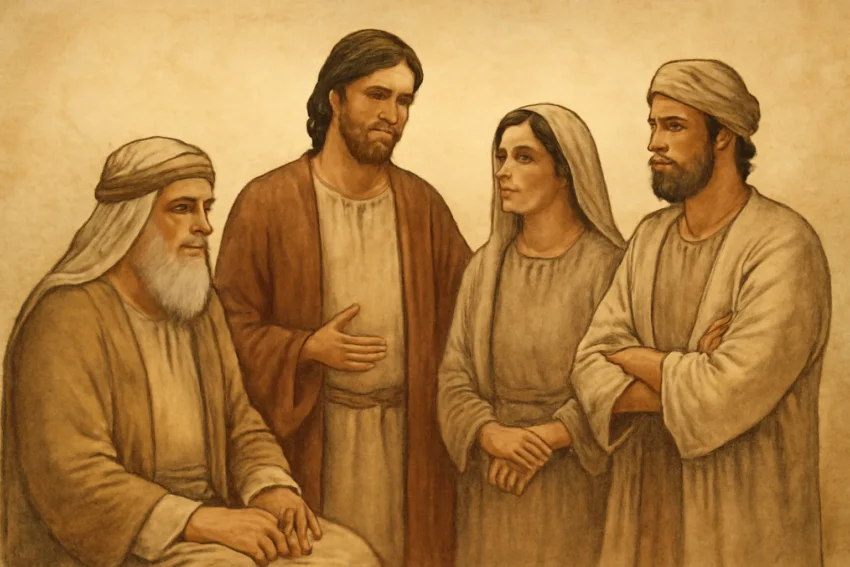
Welcome to Bible Characters: A Complete Guide to Key Figures in Scripture. This guide is designed to introduce you to a wide spectrum of figures—from the very first humans in Genesis to the early church leaders who shaped Christian faith. You’ll encounter a variety of roles and themes across the biblical narrative: creators and covenant keepers, judges and kings, prophets and poets, mothers and mentors, apostles and missionaries. By exploring these characters, you’ll gain a clearer sense of how their choices, struggles, and triumphs illuminate the contours of Scripture and illuminate the path of faith for readers today.
Origins and responsibility: Adam, the first human, and his partner, Eve, represent the beginning of humanity and the gift of stewardship over creation.
Temptation and consequence: Their choices in the Garden of Eden illustrate the human tension between desire, obedience, and accountability.
Covenant foreshadows redemption: The narrative points toward a future solution—anticipating how God will address sin and separation.
In many biblical readings, Adam and Eve are not merely ancient ancestors; they anchor themes of free will, responsibility, and the need for divine grace. Their story is less about a static fall and more about the unfolding drama of restoration that continues through the rest of Scripture.
Noah
Righteous living in a corrupt world: Noah stands as a model of faithfulness in a time when humanity had largely rejected righteousness.
Covenant through the flood: God’s promise to Noah establishes the post-Flood, or postdiluvian, covenant that safeguards future generations.
Resilience and obedience: The ark mission demonstrates how obedience to God can sustain life and preserve hope for a broken world.
The Patriarchs: Abraham, Isaac, Jacob, and Joseph
Abraham—the model of faith and obedience: a man called to become a great nation, whose covenant relationship with God shapes biblical theology.
Sarah and descendants: The narrative emphasizes promise fulfilled beyond natural expectations, pointing to divine initiative.
Isaac and Jacob—continuations of the line: Isaac’s faithfulness and Jacob’s transformation reveal God’s sovereignty in guiding the covenant lineage.
Joseph—from betrayal to leadership: Joseph’s story highlights forgiveness, Providence, and the way God works through difficult circumstances to accomplish a larger plan.
Exodus and Nation Formation
Moses
Deliverer and lawgiver: Moses leads the Israelites from slavery and receives the Law that would guide civil and spiritual life.
Prophet and mediator: He serves as a bridge between God and people, underscoring the need for mediation and prayer.
Wilderness journey: His life demonstrates perseverance, faithfulness, and the challenges of leading a people through uncertainty toward the Promised Land.
Conquest and settlement: Joshua succeeds Moses and leads Israel into the land, fulfilling a portion of the covenant promise.
Faith under pressure: His famous refrain—“as for me and my house, we will serve the Lord”—reflects steadfast devotion in the face of formidable foes.
Land and legacy: The book bearing his name emphasizes obedience, courage, and dependence on God’s guidance.
Deborah and the Judicial Era
Prophetess and judge: Deborah stands at the intersection of prophetic authority and judicial leadership, offering strategic wisdom.
Military faith: Her alliance with Barak demonstrates that courage and trust in God can transform a crisis into a victory.
Women’s leadership: The Deborah narrative highlights the worth and impact of diverse leadership within God’s people.
Kings, Prophets, and Wisdom Guides
David, the Shepherd-King
Heart after God: David’s life embodies both enormous faith and profound flaws, illustrating how grace covers real life mistakes.
Leadership and poetry: As a king and a psalmist, he models the power of worship, strategic leadership, and enduring legacy.
Covenant promise: The Davidic covenant foreshadows a ruler whose throne endures, a theme tied to later biblical fulfillment.
Solomon
Wisdom and wealth: Solomon becomes the archetype of the wise ruler who asks God for discernment for ruling justly.
Temple builder: His era produces a spiritual and architectural centerpiece that symbolizes communal worship and divine presence.
Limits of riches: The later parts of his story remind readers that wisdom must be rooted in faithfulness and humility to avoid spiritual decline.
Elijah and Elisha
Prophetic voice in a challenging era: Elijah confronts idolatry with boldness, calling people back to fidelity to the covenant.
Miracles and succession: Elijah’s ministry continues through his successor, Elisha, who performs bold signs that reveal God’s ongoing presence.
Vivid faith narratives: These prophets illustrate that faithfulness often involves courageous confrontation and compassionate action for the vulnerable.
Isaiah, Jeremiah, and the Major Prophets
Prophetic poetry and warnings: Isaiah’s visions and Jeremiah’s laments communicate God’s holiness, judgment, and hope for restoration.
Messianic anticipation: The major prophets lay groundwork for understanding the Messiah’s mission and the nature of God’s redemptive plan.
Exilic perspective: The voices in exile challenge readers to maintain faith in God’s promises amid hardship and change.
Daniel
Daniel in exile: A model of steadfast faith and intellectual integrity in a foreign culture.
Dreams and kingdoms: Daniel’s interpretations reveal God’s sovereignty over earthly kingdoms and the ultimate triumph of righteousness.
Prayer and courage: The book emphasizes perseverance in prayer and fidelity to God even when faced with danger.
Notable Women of Faith
Ruth
Faithfulness across borders: Ruth’s loyalty to Naomi becomes a powerful example of devotion that transcends kinship and nationality.
Redeemer foreshadowing: Her story introduces the idea that divine provision can be found in ordinary acts of steadfast love.
Legacy in lineage: Ruth’s inclusion in the genealogies foreshadows the kinship between generations and nations.
Providence and courage: Esther’s courage saves her people, illustrating how a single person can influence history through bold action.
Intercessory leadership: Her risk-taking demonstrates the importance of advocacy and strategic bravery in crisis moments.
Mary, Mother of Jesus
Faith and receptivity: Mary embodies trust in God’s plan, embracing a role that carries both privilege and heavy responsibility.
Magnificat as prayer: Her praise expresses a deep, faithful orientation toward God’s purposes for the marginalized and the hopeful future.
Martha, Mary, and Elizabeth
Complementary gifts: The sisters and Elizabeth showcase varied expressions of devotion—service, contemplation, and prophetic witness.
Formation of discipleship: Their stories invite readers to consider how faith shapes daily life, hospitality, and expectation.
Apostles, Disciples, and Early Church Figures
Peter (Simon Peter)
Leadership and transformation: Peter’s journey—from fisherman to a bold leader—illustrates a life shaped by encounter with Christ.
Denied and restored: His failure and restoration reveal themes of repentance and renewed purpose.
Pastoral legacy: As a prominent early church elder, Peter’s letters emphasize shepherding with care and truth.
Paul (Saul of Tarsus)
Conversion and gospel breadth: Paul’s dramatic conversion expands the reach of the gospel to Gentiles and Jews alike.
Missionary zeal: He travels extensively, establishing churches and writing letters that shape Christian doctrine and practice.
Theology of grace and faith: Paul’s letters highlight justification by faith, the role of the Spirit, and the unity of believers in Christ.
John, James, and the Other Apostles
Witnesses to the Resurrection: The apostles bear witness to the risen Christ, forming the bedrock of early Christian proclamation.
Pastoral and doctrinal guidance: Their writings address both practical church life and the core beliefs of faith.
Believers Beyond the Inner Circle
Hannah, Phoebe, Priscilla, Lydia: These figures illustrate a diversity of roles—prayer, service, teaching, and hospitality—that sustain the early church and extend hospitality to strangers.
Mentors and co-workers: The New Testament letters repeatedly acknowledge partnerships in ministry that strengthen communities of faith.
Jesus: The Centerpiece of Scripture
Jesus the Messiah, Teacher, and Healer
Incarnate Word: Jesus is described as the fulfillment of prophecy and the revelation of God’s character in human form.
His teachings: Parables, sermons, and discourses reveal the values of the kingdom—humility, mercy, righteousness, and love.
Miracles and compassion: Jesus’ deeds—healing the sick, feeding the hungry, calming storms—demonstrate God’s reign breaking into the world.
Crucifixion, Resurrection, and Ascension
Sacrifice and triumph: The crucifixion is understood as the atoning work for sin, while the resurrection confirms victory over death.
Hope for all nations: The gospel is presented as good news for every people, language, and culture.
Sending of the Spirit: Jesus’ ascension paves the way for the Spirit to empower and guide the church.
Across these biblical profiles, several enduring themes emerge that help readers understand how to apply scriptural lessons today:
Faith and trust: A common thread is trust in God even when outcomes are uncertain, as seen in Abraham’s willingness to sacrifice, Noah’s obedience, and Mary’s surrender to God’s plan.
Obedience and consequences: Characters experience the consequences of obedience or disobedience, teaching that choices matter in the stream of God’s redemptive work.
Leadership with humility: David’s weaknesses, Moses’ reluctance, and Deborah’s courage illustrate that true leadership is rooted in dependence on God and service to others.
Providence and divine timing: The stories reveal a God who works through history, sometimes in quiet ways and sometimes through dramatic interventions.
Grace and redemption: Even the brightest or most flawed figures point to a broader narrative of grace that culminates in Christ.
Covenant faithfulness: The recurring concept of covenant—between God and people—serves as the overarching frame of Scripture, guiding ethics, worship, and community life.
How to Use This Guide
Begin with figures you know: Start with well-known characters like Moses, David, Esther, or Jesus to anchor your understanding and then branch into lesser-known companions to broaden your perspective.
Track themes across characters: Create a chart or mental map of themes like faith, leadership, obedience, and covenant as they appear in different lives.
Link Old and New Testament narratives: See how events and people in the Hebrew Bible foreshadow or illuminate New Testament understandings, and vice versa.
Apply lessons to modern life: Consider how the virtues and flaws of biblical figures can inform decisions, relationships, and communities today.
Closing Thoughts: A Lifelong Journey Through Scripture
Exploring bible characters is more than cataloging names; it is about encountering a God who reveals Himself through real people, in real time, with real challenges. From the primordial Adam and Eve to the missionary Paul, from the valiant Esther who risked all to the humble Mary who conceived a holy mystery, each figure adds a thread to the fabric of biblical faith. A complete guide to these figures is, at heart, a guide to understanding God’s redemptive plan, the shape of faithful living, and the call to participate in the ongoing story of divine love and restoration.
As you continue your study, consider returning to this guide to revisit familiar names, discover new associations, and deepen your understanding of how Scripture speaks through its characters—not merely as relics of the past, but as living voices that invite readers into a dynamic relationship with God.