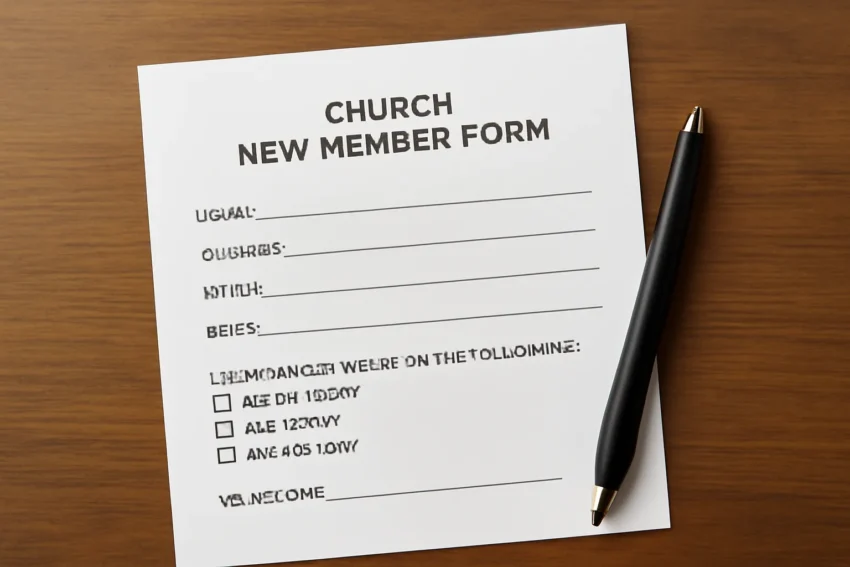
Welcome to a comprehensive guide about the church new member form, also known as the new member registration form or the membership enrollment form. This article explains why a well-constructed, free printable registration template matters for congregations of all sizes, how to tailor it to your church’s values, and practical steps to implement it smoothly in a ministry context. Whether you are building a parish intake form for a local parish, a congregation registration form for a multi-site church, or a simple member application for a small fellowship, the guidance below covers fundamentals, best practices, and customization ideas.
Overview: what a church new member form is and why it matters
The new member form serves as the first official point of contact between a visitor who is transitioning to membership and the church’s administration. A well-designed form accomplishes several important goals:
Capture basic contact information and the member’s preferred method of communication.
Document affiliation details such as baptism, confirmation, or prior church membership.
Collect emergency contact information for safety and care during church events.
Solicit volunteer interests and ministry preferences to support assimilation.
Record consent for data processing, event communications, and safeguarding policies.
Provide a concrete pathway for orientation and sponsorship in the life of the church.
A free printable template makes it easier for volunteers to collect information consistently, ensures compliance with privacy expectations, and helps pastoral staff follow up with new members in a timely, respectful manner. The intent of a printable form is not to replace a digital system but to bridge in-person interactions with a reliable, organized data record that can later be integrated into a church management system or kept in a secure, physical file if needed.
Terminology and variations: different ways to refer to the form
In practice, churches use a range of terms that describe the same process. Here are semantically related phrases you may encounter or want to include in your materials:
New member form or new member registration form
Membership enrollment form and membership application
Congregation registration form and parish intake form
Member intake form and visitor-to-member form
Church enrollment form and church membership form
Using multiple terms in your communications helps ensure clarity for diverse audiences, including first-time visitors, longtime attendees, and church staff who handle administrative tasks.
Core sections you’ll typically find in a free printable template
A practical free printable registration template typically divides information into clearly labeled sections. Here are the common blocks you will want to include, with notes on purpose and best practices.
Personal and contact information
This is the foundation of the form. Collecting accurate contact details enables you to welcome new members, invite them to relevant activities, and communicate changes to church schedules.
Full name
Preferred name or nickname
Address (street, city, state/province, ZIP/postal code)
Phone number(s) and email address
Date of birth or age range (where appropriate, respecting privacy)
Marital status (optional, depending on church context)
Emergency contact and health information
For safety and care during church events, a brief emergency contact is prudent. Consider minimal health information unless required for safety reasons.
Name and relationship of emergency contact
Emergency contact phone number
Medical considerations or accessibility needs (optional and with consent)
Spiritual background and church experience
This section helps staff understand the prospective member’s background and expectations. It can guide discussions during onboarding and mentorship pairing.
Current church affiliation or denomination
Pastor or church leader reference (optional)
Date of baptism, confirmation, or other milestones (if applicable)
Reason for visiting or seeking membership
Ministry interests and involvement
Connecting new members with opportunities is a core value of many churches. Gather volunteer interests to foster early engagement.
Preferred ministry areas (e.g., Sunday school, music, outreach, hospitality, youth)
Availability for volunteering
Interest in small groups or accountability circles
Communication preferences and consent
Clear consent is essential. This section outlines how the church will contact the member and how data will be used and stored.
Preferred communication method (email, phone, text, mail)
Consent to receive church newsletters, event notices, and updates
Consent to process personal data for membership records
Consent to participate in safeguarding and child protection policies (where relevant)
Policies and acknowledgement
Include concise statements that the applicant has reviewed key policies, such as safeguarding, privacy, and code of conduct. A space for initials or a signature is often included for formal acknowledgment.
Privacy policy acknowledgement
Code of conduct or community guidelines acknowledgement
Statement of faith or church doctrine that the member identifies with (optional)
Signature and date (or electronic signature if applicable)
Accessibility and inclusivity considerations
Design the form to accommodate diverse members, including those with disabilities or language needs. Accessibility improves participation and sense of belonging.
Simple language and clear instructions
Large print option or high-contrast design
Translations or bilingual fields (if your community is multilingual)
Privacy, consent, and data handling: critical considerations for your template
When a church collects data through a new member form, it bears responsibility for safeguarding that information. A free printable template should support responsible data handling without overwhelming volunteers with legal jargon. Here are essential practices to embed in your template and your church’s policies.
Limit data collection to what you need
Ask only for information necessary to welcome and integrate the member. Avoid collecting sensitive data that does not serve a legitimate pastoral purpose unless required by policy or law.
Clear consent and purpose statements
Provide explicit language about how the information will be used, who will access it, and how long it will be retained. A consent block with checkboxes or signature lines helps create an auditable trail.
Data retention and access controls
Outline a simple retention period and who may access the records. If you maintain digital records, consider encryption and restricted access. For paper forms, store them in a secure location with limited access.
Respect for privacy and parental consent
For families, ensure parental consent where appropriate and clarify how information about minors will be handled. Provide a process for updating information as family circumstances change.
Design considerations for a printable registration template
Layout, typography, and form structure influence how effectively a free printable template is used in real life. A well-designed form is easy to fill out by hand, legible, and quick to scan into a database if the church uses one. Here are practical guidelines to keep in mind.
Paper size, margins, and readability
Choose a standard size (letter or A4) with comfortable margins. Use a font that remains readable at small sizes and provide ample line spacing for handwriting.
Section separation and visual cues
Group related fields with clear section headers. Use bullets, checkboxes, and lines where appropriate to guide the person filling out the form. Visual cues help reduce mistakes and missing information.
Fields that accommodate handwriting
Provide lines or boxes for each field, and consider a layout that keeps related fields on the same row where possible. For longer fields such as “Address” or “Notes,” include a multi-line text area for legibility if you create a digital-to-paper hybrid template.
Accessibility on the printed page
Ensure high-contrast text, avoid overly dense blocks of text, and provide large-print options if feasible. Keep language simple and direct so people from diverse backgrounds can understand what is being requested.
Step-by-step guide to creating your own free printable registration template
Even if your church uses a different system, you can design a reliable, reusable form using the steps below. This guide emphasizes practical actions that lead to a clean, usable, and legally sound template.
Step 1: Define objectives and audience
Clarify what your church aims to accomplish with the form, who will fill it out (new members, visitors seeking membership, family units), and how the data will be used. This foundational step informs language, fields, and layout.
Step 2: Draft the field set and sections
Use the core sections outlined above as a starting point. You can add or remove fields based on your church’s practices, but keep the form focused and concise to improve completion rates.
Step 3: Create consent and policy statements
Write brief, understandable statements about privacy, data usage, and safeguarding. Include a consent line that the member signs or initials, acknowledging they have read and understood the policies.
Step 4: Choose a printable format
Decide whether you will provide a one-page form, a two-page form, or a form with multiple columns. A two-page approach can help separate contact information from ministry interests, but a single-page form is often easier for a quick intake.
Step 5: Add branding and language consistency
Incorporate your church’s logo, color palette, and preferred terminology. Consistent language across forms, bullet points, and policy statements fosters trust and professionalism.
Step 6: Pilot test with volunteers
Have a small team fill out the form as if they were new members. Observe where they hesitate, which fields cause confusion, and whether the layout is easy to navigate. Use this feedback to refine the form before wider distribution.
Step 7: Provide optional digital companion
Consider offering a digital version of the same form (e.g., a fillable PDF, a printable Word document, or an online form). A dual approach accommodates varying preferences and access levels while ensuring your data capture remains consistent.
Practical template examples: field lists, variants, and layout ideas
Below are example field groupings you can adapt. These are not exhaustive templates, but practical starting points that illustrate how a free printable registration template can be organized for ease of use.
Example A: compact one-page form
Personal information (name, preferred name, date of birth, contact details)
Address (street, city, state, ZIP)
Emergency contact (name, relationship, phone)
Ministry interests (chosen areas, availability)
Consent (privacy, communications, safeguarding)
Signature and Date
Example B: two-page layout with a dedicated ministry section
Page 1: Personal information, contact details, emergency contact
Page 2: Spiritual background, ministry interests, group affiliations, policies acknowledgement
Example C: multilingual or accessibility-friendly layout
Include bilingual prompts or a separate language section
Provide clear, simplified language for core fields
Offer large-print and high-contrast options
Implementation: how to use a print-ready template in your church workflow
Having a free printable template is only the first step. The real value comes from integrating it into a smooth workflow that respects volunteer time, preserves privacy, and supports newcomers on a path toward belonging.
Staff roles and responsibilities
Greeters and welcome team collect the form and guide fill-out; provide help as needed.
Administrative staff scan or transcribe information, ensure data accuracy, and create a member record.
Pastoral staff review intake data to offer a warm welcome, introduce mentors, or invite new members to orientation.
Safety and compliance leads ensure privacy and safeguarding policies are acknowledged and followed.
Data handling workflow
Establish a clear flow for what happens after the form is submitted. A typical flow includes: submission, initial review, data entry into the church management system (or secure file), assignment of a welcome mentor, and follow-up contact within a set timeframe.
Orientation and assimilation steps
Turn the data into action by offering an orientation session, setting up small groups, and pairing new members with seasoned church members who can answer questions and help with integration into worship and service.
Tips for maximizing effectiveness: engagement, accuracy, and sustainability
To ensure your new member form travels smoothly from screen to service to spiritual home, consider these practical tips. They address engagement, accuracy, and long-term sustainability for your church’s records and care practices.
Make it welcoming and non-intimidating
Use warm language and brief explanations for why you’re collecting each piece of information. A friendly tone helps visitors feel valued and reduces hesitation about sharing personal data.
Keep a balance between required and optional fields
Label fields clearly as required or optional. This prevents form fatigue and helps volunteers focus on essential information first.
Provide examples and help text
Inline help text or sample entries (e.g., “John Doe” for the full name field) can reduce ambiguity and improve data quality.
Coordinate with ministry leaders
Share the template with ministry leaders so they can align onboarding messages with ongoing programming. When people see continuity between welcome materials and opportunities to serve, they are more likely to engage.
Accessibility, inclusivity, and language considerations
A thoughtful church membership form respects diverse backgrounds and needs. When you design and print forms, keep accessibility at the forefront so all potential members can participate meaningfully.
Language clarity
Avoid jargon and ecclesiastical terms that may confuse first-time visitors. If specialized terms are necessary, provide a brief explanation or a glossary reference on the form or companion materials.
Inclusive data fields
Offer inclusive options for gender, family structure, and contact preferences. If possible, provide a blank line for open-ended responses where appropriate.
Adaptability for language preferences
For multilingual communities, consider providing bilingual headings and prompts, or note where translations can be requested. A bilingual or multilingual form reduces barriers to membership and support.
Common challenges and how to avoid them
Even well-designed forms can encounter bumps in real-world use. Here are some frequent issues and practical remedies.
Issue: missing information or illegible handwriting
Remedy: keep fields concise, offer checkboxes for common answers, and encourage staff to gently ask for clarification. Consider offering a digital fillable version for those who prefer typing.
Issue: privacy concerns from visitors
Remedy: include a short privacy statement near the top and ensure staff can explain data handling. If privacy is a major concern, provide a version of the form that collects only non-sensitive information during initial visits and follows up later with full consent.
Issue: integration with digital systems
Remedy: design a form that maps clearly to your database fields. Use consistent naming for fields (e.g., “email” vs. “e-mail”) to avoid data fragmentation and duplication.
Printing, distribution, and follow-up best practices
Finally, consider how the form will be distributed, collected, and followed up. A deliberate process ensures that the information gathered through the document translates into meaningful relationships and engagement opportunities.
Distribution strategies
Place a printed form on welcome tables or in visitor packets at the church entrance
Offer a brief explanation by a greeter while the visitor completes the form
Provide a digital option at the same time to accommodate different preferences
Collection methods
Use secure drop boxes for physical forms at the church office
Set up a staff member to collect and review forms at the end of services
Ensure forms are logged promptly into the central system or filed securely
Follow-up communication
Send a warm welcome message within 48–72 hours
Invite the new member to an orientation event or a small group
Provide ongoing opportunities to connect with a mentor or sponsor
Sample language you can use on a free printable template
Using clear, friendly language on your template can improve comprehension and completion rates. Below are example prompts you might adapt for your church context.
“Please share your contact information so we can welcome you and keep you informed about worship, gatherings, and ministries.”
“If you have any accessibility needs, please let us know so we can make attending church events easier for you.”
“By signing this form, you agree to be part of our church community’s care and communications, in line with our privacy policy.”
Conclusion: taking the next step with a robust, free printable registration template
A well-crafted church new member form is more than a data collection tool. It is a doorway to hospitality, belonging, and spiritual growth. By providing a straightforward, printable template that balances privacy, consent, and church life integration, you empower your congregation to welcome newcomers with clarity and care. The variations of this form—whether you call it a new member registration form, a membership enrollment form, or a congregation registration form—all share a common goal: to honor the dignity of each person who steps into the life of the church and to provide a clear path toward participation, alongside responsible stewardship of the information entrusted to the church.
If you are ready to create a free printable template for your church, start with the core sections outlined here, tailor the wording to fit your culture, and test the form with volunteers and staff. Remember to align the template with your safeguarding policies, privacy commitments, and the church’s mission to welcome, partner, and care for every member. With a thoughtful approach, your new member form becomes not only a record-keeping instrument but a symbol of hospitality that helps newcomers begin their journey with confidence and joy.
For churches seeking practical resources, there are many reputable sources that offer free printable templates adaptable to different denominations and styles. Always ensure that a template you choose or adapt complies with your local legal requirements and church policies. By combining clarity, compassion, and careful data handling, your church can create an intake process that supports both administration and relationship-building for years to come.