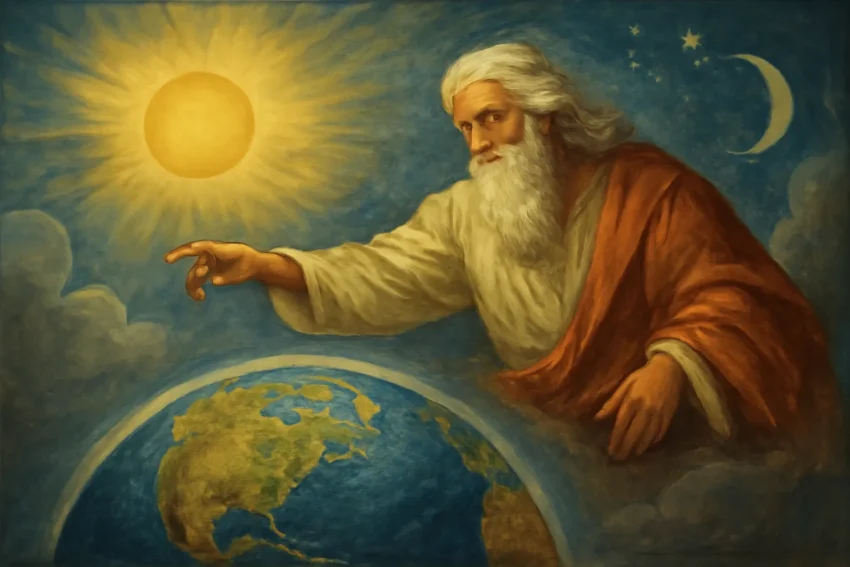
The phrase “Bible creation myth” invites careful consideration. In scholarly and theologically diverse contexts, the term myth often signals a traditional narrative that explains origins, order, and purpose rather than a modern scientific account. In the case of the Hebrew Bible and the Christian Old Testament, the primary creation narratives appear in Genesis 1 and Genesis 2. These chapters offer distinct perspectives on the same foundational questions: Where did everything come from?What is God like? and What is the place of human beings in creation? The textures of these texts—structural design, literary devices, and theological themes—have influenced centuries of interpretation, devotion, and debate.
Origins in the Biblical Text
Two Creation Narratives: Gen 1 vs Gen 2
Most scholars today recognize that the opening pages of the Bible present more than a single, simple story. In Genesis 1, the creation account unfolds as an orderly, cosmos-centered narrative. The days of creation are structured, formulaic, and sequential, culminating in the sanctification of the seventh day as a pattern for human life and worship. In this account, God—often represented by the term Elohim—speaks creation into being: “And God said, ‘Let there be light,’ and there was light.” The emphasis is on divine sovereignty, order, and the goodness of creation.
In Genesis 2, by contrast, the emphasis shifts toward a more intimate, anthropocentric portrait. The narrative foregrounds Adam and the Garden of Eden, with emphasis on relationships, life in the garden, and the naming of animals. Here the divine name shifts in flavor to Yahweh Elohim, highlighting a personal, relational dimension of God. The sequence feels less like a grand, cosmic program and more like a portrait of life as it relates to human needs, responsibility, and companionship.
Because of these differences, many scholars describe the chapters as reflecting two different theological aims or literary memories that were woven together over time. A common scholarly view is that these are not two contradictory histories but two earlier traditions—often labeled as the P source (Priestly) and the J source (Yahwist)—that were later combined by editors or redactors into a unified narrative. The result is a rich and multi-voiced introduction to the biblical worldview.
Names, Terms, and Key Motifs
The opening chapters employ several important terms and motifs that scholars and readers use to interpret the text:
Elohim and Yahweh Elohim as divine names that signal different theological emphases.
The phrase “In the beginning” as a assertion of prior existence and purpose beyond human inquiry.
The concept of imago Dei (the image of God) in Genesis 1:26–27, which grounds human dignity, rational agency, and moral capacity.
The motif of light, darkness, water, and order as elements of creation’s structure and meaning.
Descent into special creation of humans as co-regents with God in the order of creation, rather than mere observers.
The interplay of these terms and motifs invites a variety of readings. Some readers emphasize the cosmic scope of Genesis 1 and the temple-like design of creation; others highlight the intimate, relational texture of Genesis 2 and the social dimensions of human life. What unifies them is a conviction that the world is purposeful, ordered, and good, created by a God who engages with creation and invites creatures into relationship.
Historical-Critical Context and Ancient Near Eastern Context
The biblical creation narratives did not arise in isolation. They emerged within an ancient Near Eastern milieu in which several cultures told stories about the origins of the world, the gods, and humanity. Several important points help readers understand the Bible on its own terms and in conversation with its neighbors:
Enuma Elish (the Babylonian creation epic) and Atrahasis (Mesopotamian creation and flood narratives) share broad motifs with Genesis—cosmic waters, order arising from chaos, and the creation of humans to relieve gods of labor. However, Genesis reframes these ideas within a strict monotheism and without divine rivalries.
The idea of creation as a lawful, purposive act—spoken into existence by a single sovereign God—represents a distinctive Israelite articulation. Rather than competing gods or clan battles, Genesis presents God’s authority, sovereignty, and benevolence as the organizing principles of reality.
The cosmic temple motif surfaces in some readings of Genesis 1, where the seven-day pattern mirrors temple construction and dedication. The Sabbath becomes not only a day of rest but a theological signal that the cosmos itself is grounded in divine rest and divine order.
In Genesis, human beings are given dominion and responsibility, suggesting a social and ethical purpose to creation. This stands in contrast to some ancient myths that depict humanity primarily as laborers for capricious gods; Genesis casts humanity as intended stewards and image-bearers of the Creator.
Interpretive Traditions: How People Have Read the Creation Narratives
Literal, Historical, and Theological Readings
Across time, Jews and Christians have offered a spectrum of readings. Some readers treat the Genesis accounts as historically literal records of a recent creation: a fixed date, a planet arranged in a demonstrable sequence, and a straightforward six-day workweek. Others emphasize a more theological or literary reading that privileges meaning over chronology: the messages about God’s character, creation’s goodness, human vocation, and the moral order are primary, while the exact chronology or the nature of the processes may be interpretive layers that reflect ancient rhetorical strategies.
Modern discussions often distinguish between several approaches:
Day-Age theory treats each “day” as representing a longer period of time, aligning with the perception that God’s creative work transcends human temporal frameworks.
Framework Hypothesis emphasizes a literary grid or framework in Genesis 1–2 that sorts creation into two parallel domains (the heavens and the earth, plants and animals) and emphasizes order rather than sequential history.
Theistic evolution proposes that God works through natural processes (including evolution) to accomplish creation’s ends, seeking harmony between faith commitments and scientific understanding.
Young Earth Creationism and Old Earth Creationism depict different ways of reconciling the Genesis account with modern cosmology and geology, sometimes leading to divergent conclusions about the age of the earth and the timeframes of creation.
Each of these positions seeks to be faithful to the biblical witness while engaging intellectual honesty about what the texts say and what they imply about God, the world, and human life.
Symbol, Myth, and Meaning
In scholarly discourse, a myth in the ancient sense often serves as a technology for conveying meaning—how people understand the world, their place in it, and their responsibilities toward each other and God. The Genesis creation accounts are rich with symbolic language that communicates:
The inherent goodness of creation and the Sabbath rhythm as a pattern for human living.
Divine sovereignty: God’s word creates and sustains the world.
Human responsibility: humans are given stewardship and moral agency, with duties toward one another and creation.
Relationality: the narrative foregrounds relationships—between God and humanity, between humans, and between humans and the rest of creation.
A robust discussion of the Bible’s creation narratives requires addressing common misconceptions with careful distinctions:
“The Bible teaches a literal six-day creation as a modern scientific fact.” While some communities affirm a literal six-day framework, many scholars argue that the text’s primary aim is theological—asserting God’s sovereignty, the goodness of creation, and the rightful place of humanity—while the exact scientific description of cosmology is not the central goal of these chapters.
“Genesis 1 and 2 are contradictory histories.” Rather than contradiction, many scholars view them as complementary voices that emphasize different dimensions of reality: cosmic order in Genesis 1 and intimate relational life in Genesis 2.
“Creation ex nihilo means nothing existed before creation.” Biblical language communicates creation as the bringing into being of all that exists by God’s will; it does not always resolve questions about metaphysical pre-existence or the precise mechanics of cosmic bring-forth. The emphasis is on God’s initiative and authority.
“Ancient cosmology in Genesis 1-2 is a flat Earth center-world view.” The ancient cosmology uses phenomenological terms familiar to its audience, such as firmaments and waters above and below, but it is not primarily a scientific atlas. The text aims to convey truth about God, order, and purpose in language accessible to its original readers.
“Creation narratives are only about origins.” They also explain human vocation, societal structure, and ethical responsibility. The stories map a grand theology of who God is and how humans should live in relation to God, one another, and the created world.
Implications for Faith and Life
The Genesis creation accounts continue to shape questions of faith, science, ethics, and public discourse. Several practical implications emerge:
Faith and scientific inquiry can engage in a constructive dialogue when readers recognize that biblical texts convey ultimate truths about God and purpose rather than a laboratory of empirical data. Theological interpretations that respect scientific inquiry can coexist with a high view of scriptural authority.
Ethics of creation emphasize stewardship, care for the Earth, and responsibility to protect vulnerable life. The concept of imago Dei grounds human dignity and moral accountability.
Worship and sabbath rhythms emerge from Genesis 1’s cadence and the sanctification of the seventh day. For communities, this can translate into practices that honor rest, restfulness, and reverence for the Creator.
Human flourishing and relational life in Genesis 2 highlights community, companionship, and cooperation—principles that inform contemporary discussions about marriage, family, and social justice.
Variations in Interpretation Across Traditions
Across Jewish, Christian, and secular scholarly communities, interpretations of the creation narratives diverge in method and emphasis. Some traditions emphasize the moral and theological claims, others foreground the historical critical questions, and still others stress the spiritual symbolism that animates the text. These differences are not necessarily incompatible; rather, they reflect the multiplicity of ways people have encountered Scripture in different historical contexts.
Bridging Text, Tradition, and Today: Practical Approaches
Readers seeking to engage responsibly with the creation accounts might consider a few practical strategies:
Read Genesis 1 and Genesis 2 side by side and note how the perspectives shift. Observe how each narrative speaks to different questions—cosmology, order, image-bearing humanity, and relational life.
literal readings, literary readings, and theological readings. Recognize that each lens highlights different facets of meaning without necessarily negating others.
ancient Near Eastern context to appreciate how Israelite authors consciously articulates a distinctive worldview—one that centers on one sovereign creator rather than a pantheon of gods.
cosmology (the origin and structure of the universe) and spiritual anthropology (the meaning of human life and its responsibilities).
Below is a compact glossary to help readers navigate the main concepts that recur in discussions of the creation narratives:
Imago Dei — the Latin phrase meaning “image of God,” referring to the special status and responsibilities of humans within creation.
P source — the Priestly source, associated with orderly, liturgical, and cosmological material in Genesis (often linked with Genesis 1).
J source — the Yahwist source, associated with more anthropomorphic depictions of God and a different narrative style (often linked with Genesis 2).
Ex nihilo — Latin for “out of nothing,” a phrase often used to describe the biblical claim that God creates without preexisting materials, though scholars debate the exact nuance in Genesis.
Day-Age Theory — an interpretation of the Genesis 1 days as representing longer periods of time rather than literal 24-hour days.
Framework Hypothesis — a literary interpretation that sees Genesis 1 as a framework organizing creation into a functional structure rather than a strict chronological sequence.
Theistic evolution — a position that God works through natural processes (including evolution) to accomplish creation, seeking harmony between faith and science.
Cosmic temple — a reading of Genesis 1 that views creation as a temple-building act by God, with the Sabbath signifying the divine presence dwelling with creation.
Conclusion: A Living Dialogue Across Time
The Bible’s creation narratives in Genesis 1 and Genesis 2 remain among the most influential texts in world literature and religious thought. They have shaped how communities understand the origins of the universe, the dignity and vocation of human beings, and the character of God who invites creation into relationship, order, and flourishing. Interpretive traditions—whether rooted in literal or symbolic readings, whether attentive to ancient contexts or modern scientific discoveries—can enrich faith by fostering humility, curiosity, and responsibility.
Embracing the breadth of interpretation helps readers avoid caricatures and oversimplifications. A careful engagement with the text invites us to ask meaningful questions: How does the creation narrative reveal God’s purposes for life on Earth? In what ways does it challenge or reinforce contemporary ethical commitments toward the environment, science, and social justice? And how might the rich imagery of light and darkness, order and chaos, image-bearing humanity, and sabbath rest shape our daily lives as communities seeking wisdom, truth, and mercy?