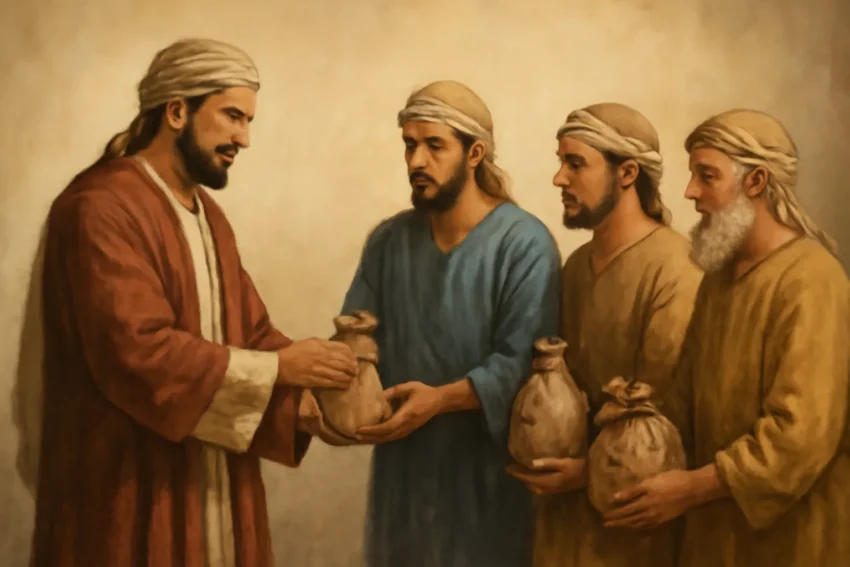
Bible Passage About Talents: Parable Meaning and Practical Lessons
The word talents in the Bible carries two intertwined ideas that illuminate a broad spectrum of
spiritual and practical life. In the parable most people associate with this term, a master entrusts his
servants with valuable units of money and expects them to use what they receive to produce more. In other,
equally important strands of Scripture, the concept expands to include gifts and abilities,
as well as the broader framework of stewardship, responsibility, and accountability before God.
This article surveys the central passages and their interpretations, showing how the same idea can be spoken of
in different biblical voices: as a money-based test of faithfulness in Matthew 25, as a leadership-laden
parable in Luke 19, and as a theological foundation for the variety of spiritual gifts and
ministries described in Romans, 1 Corinthians, and 1 Peter. The goal is not merely to recall an ancient
story but to mine practical lessons that readers can apply in their own contexts—family life, work, church
service, and personal growth.
Why this topic matters in broad Christian life
Understanding stewardship: God entrusts resources to people and expects wise, productive use.
Encouraging initiative: The parables push believers to move beyond passivity toward deliberate action.
Balancing risk and obedience: Investing or multiplying gifts often requires stepping into uncertainty with faith.
Offering accountability: There is a divine judgment about how faithfully one uses what has been entrusted.
The Parable of the Talents in Matthew: Core Text and Core Lessons
The most widely cited biblical text on talents is the Parable of the Talents in the Gospel of
Matthew. In Matthew 25:14-30, a master entrusts talents to three servants before going on a journey.
He divides the sum according to each one’s ability, gives two of them different amounts, and then departs.
The two who receive different sums immediately engage the entrusted resources in productive activity. The third,
however, not only fails to grow what was given but also actively hides it out of fear.
Key elements to notice in this text include:
Entreated trust: The master does not give to everyone the same quantity, because he knows their
capacities and responsibilities.
Active stewardship: The first two servants invest the money and earn
more. Their behavior reflects courage, diligence, and a willingness to take calculated risks.
Accountability and consequence: The master commends the faithful servants, while the unfaithful
one is called wicked and lazy, rebuked for failing to utilize what was entrusted.
A short, pointed line in some translations captures the moral: the one who multiplied what was
entrusted will be rewarded, and the one who did not is confronted with consequences. The emphasis is less on the
amount and more on the attitude toward God’s gifts—how one responds to responsibility when the owner is away.
Interpretive strands within Matthew 25
Wealth as a test: Money, property, and opportunity are tools used to reveal character.
Faithfulness over luck: The parable prizes steadiness and reliability more than quick, impulsive gains.
Return on investment: The expectation of growth underlines a broader spiritual economy—what you do with what you have matters to God.
A parallel but distinct form of the parable appears in Luke 19:11-27, often referred to as the Parable of the
Minas. In Luke’s account, a nobleman travels to receive a kingdom and entrusts ten minas to ten servants, asking
them to do business until he returns. The responses of the servants mirror the Matthew text in essential ways:
some engage and reap a return; one hides the money out of fear; the nobleman rebukes the prudent and rewards the
bold.
Different unit, same principle: The minas function as smaller or differently structured units of
entrusted resources, yet the principle remains intact: faithful service yields growth and blessing, while
fear-based hoarding leads to loss.
Accountability across scales: Luke’s version emphasizes public accountability; the returns are
public and the consequences are explicit.
Luke’s slightly different emphasis invites readers to consider how accountability operates in varying cultural
and socio-economic contexts. The core argument, however, remains: God expects prudent and courageous use of
what He provides, not mere preservation or self-protective avoidance.
While the parables in Matthew and Luke frame talents as entrusted money, other biblical passages expand the concept
to include spiritual gifts, callings, and natural abilities that believers are
invited to deploy in service to others and, ultimately, to God.
Romans 12:6-8 and the diversity of gifts
In Romans, the apostle Paul speaks of gifts given by grace, such as prophesying, serving, teaching,
encouraging, contributing, leadership, and showing mercy. Each gift is to be used in proportion to one’s faith
and for the common good.
This section invites readers to see talents not just as money but as a spectrum of God-given abilities
that require cultivation and application. The principle of stewardship extends to how we discern, develop, and deploy
our gifts in the body of Christ and in the world.
1 Corinthians 12:4-11 and the body of Christ
Many gifts, one Spirit: Paul emphasizes that diverse gifts come from the same Spirit, intended for
the common good.
Interdependence: The body has many parts; each part has a role, and all are necessary for the health
of the whole.
These verses anchor the idea that talents, whether financial, intellectual, creative, or relational, exist for
communal edification. The parable’s individual accountability sits alongside a corporate truth: the church grows
as members exercise their gifts with love and coordination.
1 Peter 4:10-11 and the duty of service
Stewards of God’s varied grace: People are urged to use their gifts to serve one another as good stewards.
Grace-enabled service: The aim is to do all in the power of the Spirit, so that God may be glorified
in every act of service.
In this strand, the concept of talents becomes a directive for practical living—use what you have to bless others,
with an awareness that God alone gives the power to do good works. The emphasis is not merely on personal achievement
but on shared advantage and the glorification of God.
Across these passages, several practical lessons emerge for living out a biblically informed understanding of talents.
Reflect on your strengths and interests as you consider how you can serve others.
Seek feedback from trusted mentors, church leaders, or coworkers who can discern where you have potential or
where you excel under pressure.
Develop a plan to invest what you have
Set concrete, measurable steps to improve a given skill or service area, such as taking a course, practicing
regularly, or volunteering for small projects that stretch you.
Pair risk-taking with wisdom: begin modestly, increase capacity gradually, and evaluate outcomes with honesty.
Practice responsible risk-taking
In the Matthew 25 sense, consider how to “invest” your time, energy, and resources in ways that could yield
beneficial outcomes for others and for God’s purposes.
Balance bold initiative with accountability—seek accountability partners who can encourage you and help you assess
the fruits of your labor.
Embrace stewardship in everyday life
Treat money, time, opportunities, and influence as entrusted resources that require wise handling.
Develop habits of generosity, prudent planning, and ethical decision-making that reflect the larger vision of God’s
kingdom.
Cultivate a community-wide perspective
Recognize that talents are not only for individual gain but for the flourishing of the entire community—family,
church, neighborhood, and workplace.
Engage in teamwork, mentorship, and service networks that enable resources to multiply and diversify impact.
The Bible’s teaching on talents is rich and sometimes nuanced. Here are answers to questions frequently raised by readers.
What exactly are “talents” in Matthew 25? In the ancient world, a talent was a large unit of wealth—a measure of money
roughly associated with 6,000 denarii. The parable uses this unit to illustrate entrusted resources and the expectation
of productive use. The broader lesson, however, scales to the idea of resource stewardship in general.
Is the emphasis on money or on gifts? Both. The Matthew and Luke accounts center on money as a concrete
form of talent, while Romans, 1 Corinthians, and 1 Peter expand the theme to include a spectrum of spiritual gifts and
callings. Together, they show that God values faithful use of all resources—material and immaterial.
What about fear or laziness? In the parable, fear and laziness are condemned. The message warns against
retreating behind excuses or hoarding what God has entrusted. Courageous, disciplined action aligned with God’s purposes
is celebrated.
How does one balance risk with wisdom? The Bible encourages wise stewardship that involves action, but not
reckless risk. Seek discernment, counsel, and prayer as you pursue productive use of your gifts and resources.
Across the scriptural landscape, several theological threads converge to illuminate a single overarching idea: God
entrusts people with resources and expects them to invest these resources for the good of others and the honor of
God. This has implications for theology, ministry, and daily life.
The nature of God’s ownership: God is the rightful owner of all things, and humans are stewards
who manage what belongs to Him for His purposes.
Human responsibility: People are accountable for how they respond to the gifts they receive—from
money and opportunities to talents and spiritual gifts.
Purpose and impact: The ultimate aim is not personal gain but the expansion of God’s kingdom and
the good of others.
Hope and grace: When we fall short, the gospel offers restoration, forgiveness, and renewed chances
to steward what remains entrusted to us.
Churches and faith communities often translate these biblical insights into programs, trainings, and cultures that foster
responsible use of talents. Here are practical ideas that align with the biblical text and yield tangible results.
Talent audits: Provide opportunities for members to identify their gifts and how they might serve in
ministry or service roles. Use surveys, conversations, and guided assessments to uncover hidden talents.
Mentorship tracks: Pair experienced leaders with newer members to cultivate skills, expand ministry
capacity, and propagate a culture of stewardship.
Micro-initiatives: Create small, time-bound projects that allow individuals to experiment with leadership
and initiative, then reflect on outcomes and lessons learned.
Accountability structures: Establish clear accountability channels, feedback loops, and transparent
processes for evaluating fruit and impact.
The goal is not merely to fill slots but to cultivate a living ecosystem in which gifts and resources are
multiplied for the sake of neighbors and the glory of God.
The Bible’s treatment of talents invites readers to reframe their understanding of success. It is less about amassing
wealth or accolades, and more about faithful stewardship—actively investing what God has entrusted, growing it, and
sharing the benefits with others. Whether seen through the Matthew and Luke parables of money, or the Romans and
Corinthians texts about gifts and service, the core call remains consistent: be faithful with what you have been given.
In this sense, talents become a bridge between an ancient narrative and modern living. They connect the
ethics of personal responsibility with the generosity that characterizes a life transformed by faith. The parables
challenge readers to move beyond passive preservation or fear-driven paralysis and toward a disciplined, hopeful
engagement with the world. When people learn to recognize, cultivate, and deploy their God-given resources—
whether financial, intellectual, or relational—they participate in a divine economy that multiplies goodness and
contributes to a more just and compassionate world.
For those who are curious to explore further, consider reading the key passages in their various contexts and
translations:
Matthew 25:14-30 (Parable of the Talents) — primary anchor for the money-based version of the story.
Luke 19:11-27 (Parable of the Minas) — parallel with different details, underscoring accountability and
expansion of the ruler’s domain.
Romans 12:6-8 and 1 Corinthians 12:4-11 — diversity of gifts within the church.
1 Peter 4:10-11 — stewardship and serving others as the authentic expression of grace.
By weaving these strands together, readers gain a richer, more actionable understanding of how to respond to God’s
entrustment in everyday life. The journey from thought to practice begins with naming what you have, cultivating it
with intention, and stepping forward in faith to multiply it for the joy of others and the glory of God.