Did the Bible Pro-Slavery Arguments Hold Up? A Critical Historical and Theological Analysis
The question of whether biblical pro-slavery arguments ever held up in history is as much about how texts are read as it is about what those texts say. Across centuries, religious, political, and economic powers have invoked the Bible to justify oppression, including slavery. Yet a careful, historically informed reading reveals a more nuanced picture: the biblical landscape includes passages that have been used to defend slavery, but it also contains a persistent, overarching trajectory toward liberation, dignity, and justice for the oppressed. This article surveys the historical context, examines the key passages that have been cited in support of slavery, and offers a critical theological evaluation of how scholars understand the Bible’s complex relationship with bondage, freedom, and human rights. The aim is not to sanitize the past or to claim that the Bible is abolitionist from the start, but to show how interpretation evolves when subjected to careful exegesis, historical awareness, and ethical reflection.
Historical Context: Slavery in the Ancient World and Early Christian Communities
To assess the legitimacy or weakness of pro-slavery readings, it helps to distinguish two layers of context: the ancient world’s social norms and the emergent Christian ethical vision. In the ancient Near East and the Greco-Roman world, forms of servitude existed that today would be called slavery or bondage, often entailing grave inequality, coercion, and dehumanization. Yet the Bible does not simply normalize such arrangements; it also reflects diverse legal and moral impulses that regulate, critique, and sometimes, albeit slowly, resist oppression.
Regulation vs. endorsement: In several places, biblical laws regulate slavery—outlining limits on abusive treatment and providing protections for slaves—while other passages describe slavery as a social fact without explicitly endorsing it as an ideal. This distinction matters for how readers interpret the text’s moral weight.
Indentured servanthood and debt bondage: Some biblical terms refer to servitude tied to debt or social obligation rather than hereditary, perpetual ownership. This raises questions about the nature of “servant” in biblical languages and how that status compares with race-based chattel slavery later practiced in other contexts.
Liberation motifs: From the Exodus narrative onward, liberation from oppression is a defining motif. The God of Israel repeatedly identifies with the plight of the enslaved and commands indignation at exploitation, a framework that abolitionist critics later emphasize when reading biblical material in justice-oriented ways.
New Testament horizons: The early Christian communities lived in a world where slavery was pervasive. Distinctive Christian ethical responses emerged, sometimes through the household codes, sometimes through letters that challenge social hierarchies by redefining identity in Christ (e.g., bearing one another’s burdens, honoring the “one in whom there is no Jew or Greek” in Galatians 3:28).
Common Pro-Slavery Passages Cited in Theological Debates
Throughout history, several biblical passages have been invoked by those arguing in favor of slavery. In many cases, those arguments rest on a particular reading of the text, a specific translation, or an appeal to a social order that treats enslaved people as property. A careful survey reveals why these readings were persuasive to some audiences—and why they are contested by others who emphasize broader biblical themes of justice and human dignity.
Leviticus 25:44-46: Often cited to support the idea of enslaving foreigners or non-Israelite populations, with the caveat that the Hebrew Bible also envisions a form of release and protection (the Jubilee) and emphasizes humane treatment in certain verses. The key interpretive task is whether this reflects a normative endorsement or a sociological snapshot of ancient law with later ethical implications.
Ephesians 6:5: “Slaves, obey your earthly masters with fear and trembling, with a sincere heart, as you would Christ.” This line is frequently quoted by those who argue that obedience to masters was a divine expectation embedded in social order. Critics, however, point out that the passage is embedded in a broader exhortation to masters to treat slaves justly, and that Paul’s language must be read within the first-century household economy rather than as a universal endorsement of slavery in every culture.
Colossians 3:22 and 1 Timothy 6:1-2: Similar instructive patterns to Ephesians, urging obedience on the part of slaves and offering a debated space for how Christian identity transforms power relations within a household or church context.
Titus 2:9-10 and 1 Peter 2:18-25: Letters that address slaves and their masters in early Christian communities, often framed to emphasize dignity and fidelity while acknowledging existing social hierarchies. The interpretive challenge is whether these passages advocate for slavery as an institution or seek to redeem it within the constraints of a particular time and culture.
Philemon (the letter to Philemon about Onesimus): On its face, it negotiates a slave-master relationship and calls for a transformation of that relationship in Christian terms—“no longer as a slave but as a beloved brother.” Critics contend that this letter invites a reorientation of social norms, but some readers claim it leaves the master in a position of authority. The nuance lies in how one reads conversion, personal ethics, and communal life in the early church.
Genesis 9:18-27 (the Noah/Canaan narrative often linked to the “curse of Ham”): This text has historically been used to justify racialized hierarchies. Modern scholarship recognizes that the passage’s historical and theological meanings are complex, and that the interpretation historically used to justify racism rests on a faulty reading of the text and context.
1 Corinthians 7:21-23 and 1 Corinthians 7:20-24: The apostle Paul’s addresses to believers in mixed social situations leave room for dialogue about one’s social status, but the broader Christian message about freedom in Christ complicates any simple “authorization” of slavery by analogy.
It is important to note that, in many cases, the exact wording and categorization of these passages depend on translation choices and interpretive frameworks. The same verse can be read as endorsing, regulating, or subtly undermining servitude, depending on the interpretive angle, the historical moment, and the theological commitments of the reader.
In addition, several of these passages exist alongside counter-narratives within the biblical corpus that emphasize liberation, equality, and justice for the oppressed. The tension between these strands is not merely academic; it has shaped how communities have read the Bible in times of social upheaval, such as in abolitionist movements and civil-rights struggles.
Historical Use in the United States and Other Contexts
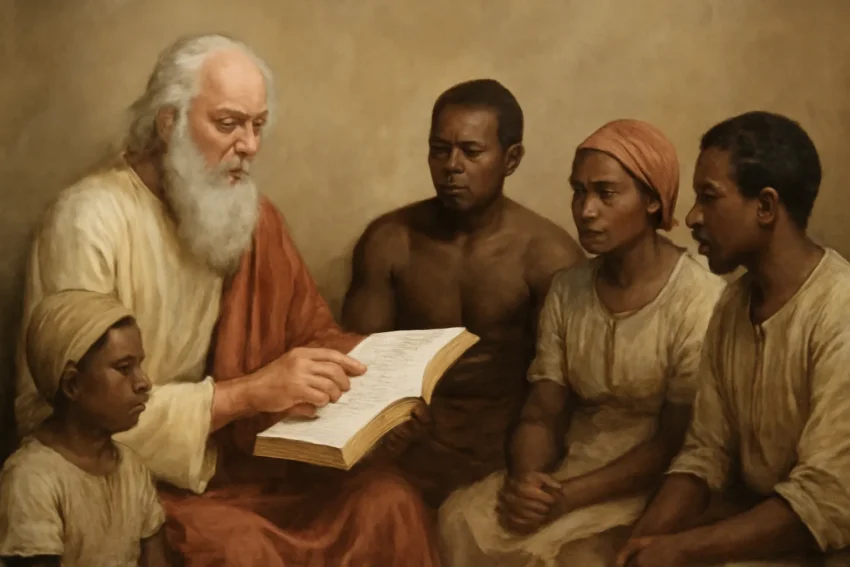
In the United States, as in other societies with entrenched systems of slavery, biblical interpretation played a central role in shaping public conscience and political policy. Some readers and institutions leaned on the biblical pro-slavery readings to defend slavery as part of a divine order or natural hierarchy. Others challenged those claims by appealing to broader biblical themes—particularly those of freedom, justice, and the inherent dignity of every person created in the image of God.
A legal-theological defense: Pro-slavery arguments often paired biblical texts with secular rationales about property, contract, and social order. The corollary claim was that excerpted verses could be used to justify the ownership of human beings as a form of economic arrangement compatible with divine sovereignty.
Abolitionist counter-readings: Abolitionists frequently foregrounded biblical motifs of deliverance, liberation, and universal brotherhood. They argued that the Bible’s overarching message—God’s concern for the oppressed and the call to justice—supports emancipation and equality under God.
The historical turning points: Debates intensified as millenarian and republican ideals aligned with religious liberty. Denominational splits, revivalist movements, and the emergence of scriptural criticism contributed to divergent readings that moved some communities toward abolition and others toward preservation of the status quo.
Beyond the United States, other Christian, Jewish, and secular scholars have engaged similar debates. In many contexts, readers emphasize how historical-critical methods—including textual criticism, sociocultural analysis, and historical reconstruction—challenge the claim that the Bible provides a timeless blueprint for slavery. Instead, they reveal a text that has been interpreted differently across time and space, depending on the reader’s ethical commitments and social location.
Several streams of theological critique have highlighted why pro-slavery readings of the Bible do not hold up as a universal or final theological verdict. These analyses converge around a few central claims:
Contextual humility: The moral authority of biblical texts increases when interpreters acknowledge historical distance and the original world behind the wording. What was permissible in ancient law does not automatically translate into a normative command for present-day ethical life.
Canon-wide critique of oppression: The biblical canon as a whole presents a trajectory from oppression toward liberation (exodus, prophetic calls for justice for the marginalized, and the overarching message of the Gospel that Jesus brings freedom to the captive). This arc often weighs against any sustained endorsement of human bondage.
Christological reframing of social order: The life and teaching of Jesus emphasize love, mercy, and the intrinsic worth of every person. The New Testament’s insistence on the equal dignity of all who are in Christ (Galatians 3:28; Colossians 3:11) challenges any reading that reduces people to property or hierarchy under God.
Ethical inversion in Pauline circles: While Paul writes within and to specific social structures, many scholars argue that the deeper (and revolutionary) impulse of his letters is to situate identity in Christ rather than in social status. This has been used to advocate for emancipation from oppressive structures and for mutual respect within Christian communities.
Scholars also stress that modern exegesis benefits from looking at genre and rhetoric: narrative, law, wisdom, poetry, and letter all operate with different aims. A master narrative about freedom and dignity is often more convincing when supported by multiple strands—prophetic critique, psalmic justice, and ethical commands of love—than any single proof-text.
Another important critique concerns translation and historical memory. Some translations of passages about slavery reflect the social world of their translators, not necessarily the moral conclusion the text would reach if read with modern critical methods. This has made it essential for contemporary readers to consult multiple translations, ancient languages, and scholarly commentaries to avoid slippery and sweeping conclusions.
Reading the Bible with Justice: Hermeneutical Approaches
How scholars interpret contested material hinges on their hermeneutical approach. Several contemporary methods help illuminate why some pro-slavery readings falter under scrutiny, while more emancipatory readings gain traction:
Historical-critical hermeneutics: Places biblical texts within their original historical, cultural, and literary contexts to identify what the text would have meant to its first readers and what that implies for today.
Canonical approach: Reads individual passages in light of the whole Bible’s narrative arc, especially the biblical commitments to justice, mercy, and the dignity of all humans.
Hermeneutics of liberation (often associated with liberation theology): Reads Scripture through the lens of liberation for the oppressed, emphasizing social transformation, solidarity with the marginalized, and action against systemic injustice.
Ethics of charity and neighbor-love: Emphasizes Jesus’s ethical commands to love one’s neighbor and to treat others as one would wish to be treated, thereby challenging any interpretation that reduces people to property.
Context matters is a guiding principle. A straightforward appropriation of ancient regulations to justify modern forms of domination misreads both the text and its intended ethical horizon. Theologically informed readers often insist that the Bible’s moral imperative moves toward freedom, dignity, and the protection of human flourishing, not toward the legitimization of oppression.
Implied Critiques Within the Text
While some passages have been cited in defense of slavery, other parts of Scripture quietly undermine that defense by positioning God as defender of the vulnerable and by calling communities to fair dealing, mercy, and justice.
Prophetic literature consistently calls for justice for the marginalized and critique of social oppression.
Christ’s ministry includes a focus on the poor, the prisoner, and the outsider, signaling a pivot toward a Gospel that challenges status-based domination.
Paul’s letters, though set within a specific social matrix, repeatedly invite believers to a higher standard of love that transcends mere social hierarchy.
Methodological Lessons: How to Read Contested Texts
For readers today, the methodological takeaway is essential: do not extract a single line and treat it as an oracle for all time. Here are practical guidelines that scholars and thoughtful readers use to navigate contested material:
Distinguish descriptive and prescriptive language: Some verses describe reality without endorsing it; others lay down normative commands. The difference shapes ethical conclusions.
Consider audience and purpose: Letters and laws often address specific communities facing particular problems. Understanding the audience helps avoid universalizing cautions or endorsements.
Analyze power dynamics: Who has authority? What are the social structures at play? How do commands address the subjugation of vulnerable groups?
Evaluate interim solutions vs. enduring principles: Some texts propose pragmatic regulations in a given culture; others point to timeless ethical standards (dignity, love, justice) that inform ongoing moral discernment.
Cross-textual synthesis: Compare passages across the canon to see how themes of freedom, justice, and neighbor-love repeatedly surface and challenge oppression.
Why the Pro-Slavery Arguments Were Not Theological Necessities
There are several reasons why the claim that the Bible endorses slavery as an unchangeable divine norm does not withstand rigorous scrutiny:
The Bible’s ethical trajectory: The arc from oppression toward justice is visible across law, prophets, and gospel. Even when slavery appears in the text, the overarching biblical witness often moves toward emancipation and dignity for all people.
Rhetorical and historical limitations: Many pro-slavery claims rely on isolated verses, translation choices, or selective memory of the ancient world. They do not capture the spectrum of biblical voices, genres, and prophetic indictments of oppression.
Contextual reinterpretation: As societies have evolved, communities of faith have reinterpreted biblical materials in ways that affirm human rights, equality before God, and the moral obligation to resist oppression—even when the texts themselves do not present a single, monolithic stance.
Ethical causality: The moral responsibility for interpreting scripture lies with the reader in dialogue with the broader tradition. Institutions that used the Bible to justify slavery often did so in ways that reflected their own economic and political interests rather than the text’s universal ethical claims.
In short, the claim that pro-slavery arguments can be read as a definitive theological conclusion collapses under careful scholarship that attends to historical context, textual diversity, and the Bible’s deeper ethical horizon.
Conclusion: Reframing the Question and Moving Forward
Did the Bible pro-slavery arguments hold up? The careful, historically aware answer is nuanced. While certain passages have been invoked to defend slavery, a robust historical-theological analysis shows that these readings do not establish a timeless, universal endorsement of oppression. Instead, the Bible’s own narrative—woven through liberation motifs, prophetic critique, and the central Christian claim of human dignity in Christ—points toward a moral horizon that ultimately questions and resists slavery as an institution in any era that cherishes justice.
For readers today, the most constructive approach is to recognize how interpretations change with time and to engage Scripture with humility, attention to historical context, and fidelity to the central biblical commitments to justice, mercy, and the value of every human being. The conversation about slavery and Scripture, then, becomes a case study in how communities of faith navigate difficult texts, disputed readings, and the moral commitments of their own cultural moment.
Ultimately, the question is not only about historical readings of biblical pro-slavery arguments but about how contemporary faith communities choose to live out the Bible’s deeper call to freedom and love. In that sense, the Bible’s long arc away from oppression—toward the dignity of every person in God’s image—is the most compelling datum for readers seeking ethical clarity in the modern world.