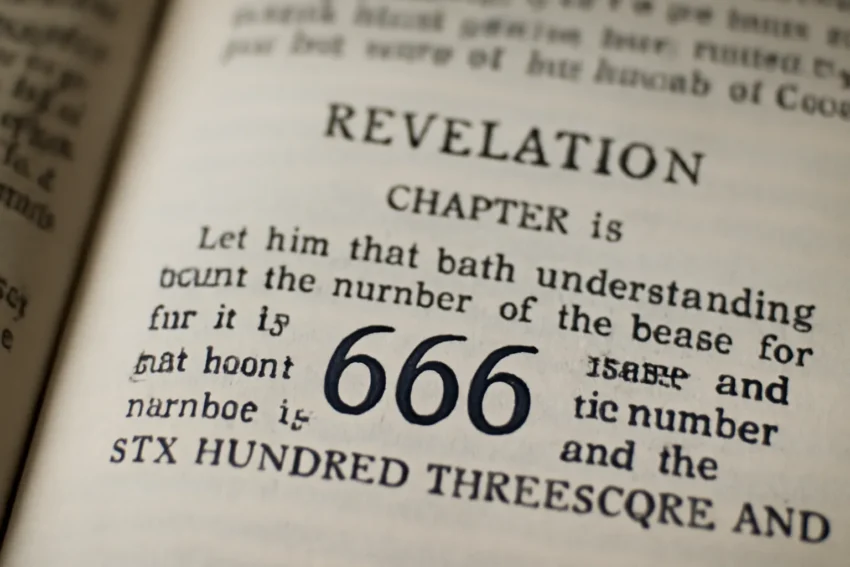
The number 666 has echoed through centuries as one of the most controversial and debated symbols in biblical literature. In the Book of Revelation, the verse commonly cited as the source of this symbol is Revelation 13:18, a terse line that has sparked a wide range of interpretations. This article offers an informative and balanced exploration of what the verse says, how it has been read across different translations, and the major scholarly approaches to understanding its meaning. It also situates the verse within the broader message of Revelation and discusses the enduring relevance of the passage for readers today.
What is the Meaning of 666?
The phrase at the heart of the verse is the number of the beast, described as the number of a man and given as Six hundred sixty-six (or its variants in English). The line begins with a summons to wisdom: “Here is wisdom” or “This calls for wisdom” in many English translations. The core idea in most scholarly readings is not a casual puzzle but a call to discernment about a powerful and perilous system or figure.
Several key phrases recur across translations and commentaries:
“Here is wisdom” or “This calls for wisdom” — inviting the reader to pause, think carefully, and apply discernment.
“Let him who has understanding” or “Let the one who has understanding” — stressing that insight and knowledge are required to interpret the symbol correctly.
“the number of the beast” — indicating that the number is a defining characteristic of the beast or the system it represents.
“the number of a man” — signaling that the symbol is tied to human agency, not a distant abstraction.
“Six hundred sixty-six” or its variants in different translations (e.g., six hundred and sixty-six, six hundred threescore and six).
Given this compact construction, scholars emphasize that the verse is less a literal codebook and more a window into a broader critique of oppressive power. The three sixes in a row have often been read as a deliberate imperfect number, contrasting with seven, the biblical symbol of perfection and completeness. Some interpreters see 666 as imperfection tied to human authority, a number that stands in opposition to divine perfection.
Textual Variations of Revelation 13:18
Because translations differ in handling the ancient Greek text, the exact wording of Revelation 13:18 can vary. Here are representative renderings from several well-known English translations:
KJV (King James Version):“Here is wisdom. Let him that hath understanding count the number of the beast: for it is the number of a man; and his number is Six hundred threescore and six.”
ESV (English Standard Version):“This calls for wisdom: let the one who has understanding calculate the beast’s number, for it is the number of a man, and his number is 666.”
NIV (New International Version):“This calls for wisdom. Let the one who has insight calculate the number of the beast, for it is the number of a man. That number is 666.”
NRSV (New Revised Standard Version):“It is the number of a human being, and its number is 666.”
Some modern translations opt for simply rendering the phrase as a literal number: “the number is 666”, while others preserve the more archaic wording of the King James tradition. The essence across translations remains consistent: a call to wisdom, a phrase about the number, and the identification of the number as a human symbol.
Beyond English, scholars note that the original Greek words provide options for interpretation. The word often translated as number is arithmos, and the phrasing around beast and man has generated a spectrum of interpretive possibilities. Some readers also point to recipient-language echoes in the early Christian milieu—especially how readers would have thought about Caesar and imperial power.
To understand Revelation 13:18, it helps to see how its imagery sits within the larger prophetic work. The Book of Revelation uses striking symbols—beasts, beasts’ numbers, seals, trumpets, bowls—to convey the ultimate clash between divine sovereignty and earthly powers. In the chapter surrounding 13, two beasts are described: the first beast rising from the sea, and the second beast from the earth. The first beast is frequently linked to oppressive political authority, while the second beast functions as a deceptive religious or propagandist power that compels allegiance to the first beast.
The verse in question appears in a passage that invites readers to discern the moral and spiritual dynamics at play. The phrase “the number of the beast” is less a casual curiosity and more a pointer to a pattern of control—economic, religious, political, and cultural—that can push people away from faithful allegiance to God. Readers throughout history have recognized that Revelation’s imagery is designed to provoke critical reflection, not merely to forecast a single future event.
Historical and Hermeneutical Approaches
Over the centuries, scholars have proposed several distinct interpretive frameworks for Revelation 13:18. Each framework has strengths and limitations, and many readers find it helpful to explore multiple angles to gain a richer understanding.
Historical and Preterist Interpretations
In historical or preterist readings, the events and symbols in Revelation are understood primarily as referring to first-century realities. In this view, 666 is often connected to figures or systems associated with the Roman Empire and its rulers, notably Nero Caesar. Some proponents of this approach argue that the numerical value of “Nero Caesar” (when calculated in Hebrew gematria) yields 666, thus wrapping the prophecy in a concrete historical moment.
In futurist readings, the number 666 is associated with a future, end-times figure or system that will arise in the last days. Proponents of this view often interpret the verse as a warning about a climactic political-religious power that demands allegiance and participation in a mark or system that opposes God.
Pros:
Cons:
Idealist or Symbolic Interpretations
The idealist approach treats Revelation’s images as universal patterns rather than specific historical or future events. In this reading, 666 symbolizes imperfection, human rebellion, and the limitations of worldly power, rather than identifying a particular person or regime. The text’s emphasis on wisdom and understanding remains central: readers are encouraged to discern the ongoing struggle between competing authorities and the call to faithfulness.
Gematria and Linguistic Considerations
Gematria, the practice of assigning numerical values to letters, has often been part of the interpretive toolkit for 666. The argument that “Neron Caesar” yields 666 in a Hebrew or Aramaic gematria is one of the most famous examples. But gematria is not the only linguistic angle; some scholars stress that a deliberate transgender of language (e.g., how the name would be rendered in Greek or Hebrew) could yield a similar numerical result. Others caution that the exact calculation hinges on the chosen alphabet, transliteration, and historical context.
Why the Number 666 Has Enduring Significance
The appeal and fear around 666 come from several forces colliding in the text:
Symbolic weight: Six is often seen as an imperfect number in biblical numerology, and triple repetition intensifies that imperfection.
Historical memory: The Roman Empire’s reach and the persecution of early Christians created a lasting memory of oppressive power as a potential “beast” in biblical memory.
Practical warning: The verse offers a practical caution: discernment is essential when confronted with systems that demand unwavering loyalty, especially when they co-opt religious language for political ends.
Literary craft: Revelation uses apocalyptic imagery to communicate truth under pressure, and the sparing use of words emphasizes the drama of the moment.
In modern culture, references to 666 often appear in literature, cinema, and popular discourse. For many readers, the symbol serves as a reminder to examine authority structures, resist coercive propaganda, and prioritize ethical commitments that align with their beliefs. The enduring relevance lies in the instruction to seek wisdom and to recognize how power can be presented as virtue while moving people away from integrity or compassion.
Practical Takeaways for Readers
Whether you approach Revelation 13:18 from a historical, futuristic, or symbolic angle, several practical lessons emerge that can guide contemporary readers:
Wisdom and discernment are essential when evaluating powerful institutions, especially when they co-opt sacred language for political or economic ends.
Human systems are fallible; the number being described as “the number of a man” signals that human authority is capable of both ingenuity and error, and sometimes moral risk.
Reading in community matters. Different traditions and scholars bring diverse insights, which can illuminate aspects you might miss when reading alone.
Context matters; understanding the historical circumstances of Revelation helps prevent projection of contemporary fears onto ancient texts.
Humility about interpretation; given the range of legitimate readings, it can be wise to hold interpretations with care and openness to new evidence or nuance.
Common Misinterpretations and Cautions
A verse like Revelation 13:18 invites careful handling; misinterpretations can emerge if one isolates the number from its narrative and symbolic context. Some common cautions include:
Do not fixate on a single figure without considering the broader symbolic landscape and the ethical concerns Revelation raises about power and worship.
Beware of cherry-picked numerology that reads 666 into everything and ignores the textual nuances and historical background.
Avoid sensationalism that treats 666 as a purely modern conspiracy code; the text invites a more measured, interpretive approach anchored in its own literary world.
Further Resources and Pathways for Study
If you want to explore Revelation 13:18 further, here are several avenues that scholars and thoughtful readers often find fruitful:
Commentaries on the Book of Revelation from different interpretive traditions (historical, futurist, idealist, and spiritual).
Academic works on biblical numerology and ancient gematria, including studies of how early readers understood symbolic numbers.
Translations and Bible study resources that compare how Revelation 13:18 is rendered across major English versions and languages.
Introduction or overview texts on the Book of Revelation that situate 13 within the broader narrative arc (seals, trumpets, bowls, and the final judgment).
For accessible, contemporary discussions, you may consult reputable study Bibles, online theological libraries, and reputable educational sources that explain the historical context and the range of scholarly interpretations without sensationalism.
Key Takeaways
In sum, Revelation 13:18 presents a compact but dense invitation: to apply wisdom and to discern the number that characterizes a public, human-made system of power. The exact rendering of the verse varies with translation, but the core ideas stay resonant: a call to careful thought, a reminder that human authority can be both persuasive and dangerous, and an invitation to faithfulness that transcends fear.
Whether you read 666 as a historical allusion, a future forecast, or a symbolic representation of pervasive rebellion against the divine order, the verse remains a touchstone for thinking about power, responsibility, and conscience in any era.
As you continue your study, approach the text with respect for its literary craft, awareness of its historical setting, and humility about the range of legitimate interpretations. The enduring question—what does it mean to live with wisdom in the face of powerful forces—continues to speak to readers in every generation.