Acts 17 Commentary: Verse-by-Verse Analysis, Context, and Applications
Acts 17 is a pivotal chapter in the Luke-Acts narrative that showcases Paul’s adaptability as a missionary in three very different settings: the Jewish synagogue context of Thessalonica, the receptive but critical crowd of the Bereans, and the highly cultured, philosophically saturated city of Athens. This chapter is often studied not only for its historical details but also for its rich theological insights into evangelism, apologetics, and contextual ministry. In this article, we will walk through Acts 17 verse by verse (in the sense of section-by-section commentary), situate the passage in its historical and literary context, and draw practical applications for contemporary readers who seek to share the message of Jesus in diverse cultural landscapes.
The following commentary adopts several angles: historical-critical context, literary structure, theological themes, and pastoral application. Throughout, we highlight key ideas in bold to emphasize the main takeaways, and we include alternatives or variations in interpretation where scholars disagree or where different Christian traditions read the text differently. This approach helps readers see how Acts 17 functions as a model for engaging with listeners who come from different backgrounds—religious, philosophical, or secular.
Context and Setting: Why Acts 17 Matters
Before we dive into the verse-by-verse aspects, a brief context clarifies the stakes. Luke portrays Paul traveling through the Greek-speaking world with a message about the Christ who rose from the dead. The narrative moves quickly from debate and opposition in the synagogue of Thessalonica to the more open but intellectually rigorous climate of Berea, and finally to the Areopagus in Athens, a place associated with philosophical discourse and civic religion. The contrasts among these settings illuminate different facets of evangelism, including how the gospel interacts with Jewish expectations, Gentile skepticism, and philosophical inquiry.
Key thematic threads recur: contextualization without compromise, the universality of the gospel, the tension between idolatry and true worship, and the claim that God is near to all who seek Him. The chapter invites readers to reflect on how to present the gospel with respect for listeners’ intellectual and cultural commitments while remaining faithful to the biblical message.
Verse-by-Verse Commentary: Sectional Walkthrough
Verses 1–9: Paul in Thessalonica—Reasoning with Jews and Gentiles, and Overnight Opposition
In these opening verses of Acts 17, Paul and his companions pass through Amphipolis and Apollonia on their way to Thessalonica. Luke emphasizes that Paul’s pattern is to preach in the synagogues (as was typical for him) and «reason» from the Scriptures that Jesus is the Messiah. Several strands emerge here:
Reasoning from the Scriptures: Paul demonstrates a method rooted in biblical exposition. He demonstrates that the gospel can be shown to be true through the scriptures, argumentation, and persuasion grounded in Old Testament expectation.
Response diversity: Some Thessalonians believe, including a handful of prominent women, but others oppose the proclamation. The opposition is not merely rhetorical; it becomes violent disruption, leading to accusations and a political or social uproar. This pattern—gospel proclamation meeting resistance—recurs in various forms throughout Acts.
Protection and provision: The narrative shows that Paul’s team is directed to move when opposition escalates, and the city authorities are instrumental in restoring order. The character of Jason and other believers who host Paul becomes a sign of the nascent church’s social network under pressure.
Gentile receptivity and Jewish opposition: The two groups illuminate the tension within early Christian mission—some Gentiles are drawn to the gospel, while certain Jewish leaders react with envy or hostility. The dual response invites readers to consider how to navigate mixed audiences in contemporary ministry contexts.
From a theological perspective, these verses highlight the gospel’s potency and the friction it may generate within entrenched communities. A common modern reading is to draw wisdom on how to plead a case for Christianity in a manner that is culturally intelligible but theologically faithful. The exhortation is not to water down the truth but to present it in a way that respects listeners’ frameworks while inviting a personal encounter with God.
Verses 10–15: The Bereans—Noble-Mindedness and Diligent Sifting of Truth
After the Thessalonian uproar, Paul’s team travels to Berea, where they are well received by those who examine the Scriptures daily to verify the message. Luke’s depiction of the Bereans is often cited as a model for biblical literacy and intellectual honesty. Key observations in these verses include:
Receptivity paired with scrutiny: The Bereans do not simply accept Paul’s teaching on authority; they compare it with the Jewish scriptures. This combination of openness and critical examination marks a constructive model for modern Christian ministry in which truth claims are tested against reliable sources.
Motivation of good character: The Bereans’ eagerness to verify aligns with a broader biblical ethic: truth discernment should accompany humility and teachability, especially when encountering a powerful message from a traveling evangelist.
Propagation of the gospel: The result of Berean diligence is that many believe, including prominent Greek men and women. The reach of the gospel extends beyond ethnic or religious boundaries into broader civic life.
Return to Thessalonica: When the gospel moves, it can provoke further opposition or support elsewhere. The movement from Berea to Thessalonica underlines the dynamics of early Christian mission, where truth claims ripple through communities as people respond in diverse ways.
From a pastoral angle, the Bereans demonstrate how critical engagement with Scripture can strengthen faith and protect against credulity or hype. A contemporary takeaway is the importance of sound doctrine coupled with humble curiosity—a posture that welcomes examination rather than fear it.
Verses 16–34: Paul in Athens—Areopagus Sermon, Contextualization, and the Call to Repentance
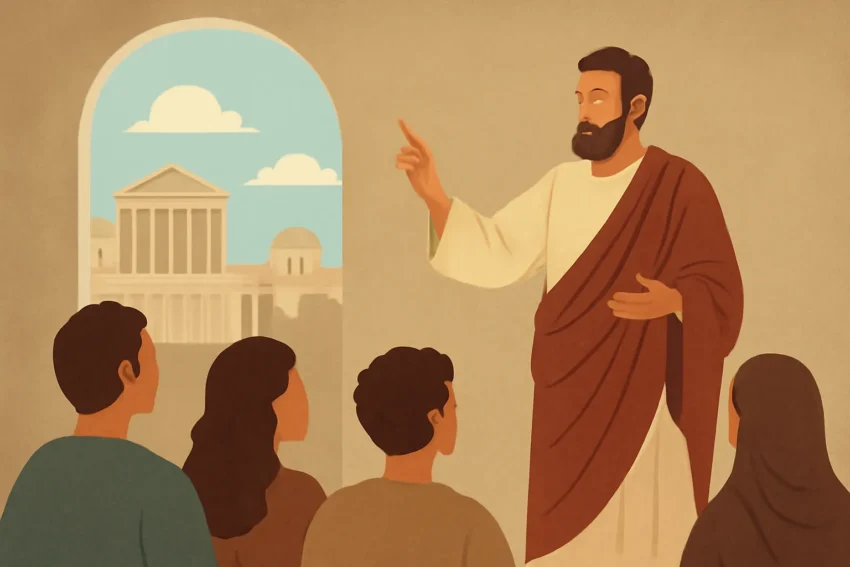
In Athens, a city saturated with temples, statues, and philosophical schools, Paul faces a different audience: intellectuals, poets, and philosophers who are steeped in civic religion and speculative inquiry. The Athens episode is often treated as the high-water mark of Paul’s cultural apologetics—how to speak truth into a city known for its religious pluralism and philosophical skepticism. Several noteworthy features emerge:
Paul’s mood and strategy: Luke notes that Paul was distressed in his spirit by the city’s idolatry. The emotional dimension signals that mission is not a cold rhetoric but a response to human brokenness. Paul then chooses a path of engagement through common ground and cultural bridges, which is vital for any cross-cultural ministry today.
Areopagus venue: The Areopagus (Mars Hill) was a place for civic discourse and moral philosophy. Paul does not reject philosophy; instead, he engages with it by recognizing common points of contact, such as creeping religiosity and humanity’s innate sense of the divine.
Use of Greek poets: Paul quotes two Greek poets—Epimenides and Aratus—to make a bridge to his audience: “In him we live and move and have our being” echoes a truth about human dependence on the Creator. This is a critical example of contextualization—speaking in a way that resonates with listeners’ own cultural references while moving toward biblical truth.
Unknown God and the invitation to repentance: Paul identifies a religious impulse within their own culture—an area of shared search for the divine—and redirects it toward the Christian claim that the true God has determined the bounds of life and times. The keynote is not mere polemics but invitation to know the personal God who is not far from any one of us.
Resurrection as a hinge event: The central controversial claim that Jesus rose from the dead functions as the decisive pivot. For some, this is a stumbling block; for others, it becomes the basis of faith. This emphasis on the resurrection has implications for contemporary preaching: the proclamation of Easter reality is foundational for Christian proclamation, even in pluralistic cultures that may resist it.
Interpretive variations abound regarding Paul’s method in Athens. Some scholars view the speech as exemplary apologetics—a gracious, non-coercive appeal to reason and culture. Others emphasize the limits of the speech, noting that some listeners dismissed it or mocked it, whereas a minority believed. A balanced reading recognizes both the power of contextualization and the reality that not all listeners respond positively to the gospel message.
From a pastoral standpoint, Paul’s approach in Athens offers a blueprint for urban ministry today: engage with people’s questions and philosophies, acknowledge their sincere religious impulses, use common ground from their own culture, and point toward the unique claim of Jesus’ resurrection. The text invites modern believers to reflect on how to handle philosophical objections, how to leverage cultural references, and how to maintain allegiance to the gospel while meeting people where they are.
Thematic Deep Dives: Theological and Literary Threads
Acts 17 weaves together several enduring themes that recur in Luke-Acts and in New Testament theology more broadly. Here are some core themes to note:
Universality of the gospel: The narrative underscores that the message of Christ speaks meaningfully to Jews, non-Jews, philosophers, and civic leaders alike. The gospel’s reach is not limited by ethnicity or social status; it addresses the whole human race.
God’s proximity and initiative: The claim that “God is not far from any one of us” (Acts 17:27) emphasizes God’s initiative in creation and history. The missionary task is fundamentally about revealing this divine proximity through proclamation and witness.
Idolatry and true worship: The lament over idols in Athens highlights the human tendency to substitute the living God with crafted images or ideas. The corrective is worship shaped by knowledge, relationship, and fidelity to the true God revealed in Jesus Christ.
Reason and faith: Luke presents an interplay between reasoned argument and revelation. The text invites readers to see faith not as blind assent but as a response to credible testimony, evidenced in the resurrection and in transformed lives.
Resurrection as impulse to belief: The claim of Jesus’ resurrection is not merely a theological assertion; it is presented as the historical event that validates all other claims about God, creation, and salvation. The resurrection functions as the decisive criterion for verdict—belief or disbelief.
Different interpretive traditions stress various angles of these themes. A traditional evangelical reading might emphasize the necessity of personal conversion and the proof of the resurrection. A more contextual or missional reading might stress cultural engagement, social compassion, and the multi-faceted approach to presenting the gospel in diverse settings. Accepting these variations can enrich both personal devotion and public proclamation.
Applications for Today: How Acts 17 Speaks into Modern Faith Practice
What practical lessons can modern Christians draw from Acts 17? Here are several areas of application that echo from Thessalonica to Athens:
Develop a thoughtful apologetic: Following Paul’s example, contemporary believers can learn to present the gospel in a manner that is intellectually engaging and biblically grounded. This means equipping ourselves to address questions about meaning, purpose, identity, and the problem of evil—without retreating from the core claims of Christianity.
Embrace cultural sensitivity without compromise: Contextualization is a balancing act. The goal is to translate the truth of the gospel into frameworks that listeners recognize, while remaining faithful to the biblical message about Jesus, the cross, and the resurrection.
Respect honest inquiry: The Bereans model a posture of diligently checking claims against Scripture. In today’s world, this can translate into humility in conversation, openness to critique, and a commitment to truth-seeking that honors the integrity of listeners.
Engage in city and university culture with courage: Athens represents a high-cultural environment where ideas are debated publicly. Modern believers can learn to engage academic, artistic, and intellectual hubs with thoughtful rhetoric, hospitality, and patient testimony.
Preach the resurrection as a defining claim: The sermon in Athens pivots on the resurrection. The practical challenge for contemporary churches is articulating how a historical event bears personal significance—identity, purpose, and hope—in a world saturated with relativism and skepticism.
Invite personal response, not mere assent: Acts 17 shows that belief is not inevitable. Some reject, while others believe. The responsibility of the messenger is to invite response—trust, repentance, and allegiance to Christ—while acknowledging human freedom and spiritual resistance.
In addition to personal evangelism, Acts 17 offers guidance for church life in diverse settings: language use that resonates with listeners’ experiences; services and messages that address questions about life’s meaning; and ministry that demonstrates integrity, care, and service within the local community. The narrative also invites reflection on the role of the church in civic life, as believers witness to God’s rule in public spheres without coercion or coercive power.
Alternative Readings and Scholarly Variations
Scholarly discussions around Acts 17 show a range of perspectives. Some emphasize the theological significance of the resurrection as the central component of Paul’s proclamation. Others highlight the rhetorical craft of the Areopagus address, treating it as a model of philosophical persuasion rather than primarily a doctrinal sermon. Still others highlight the social and political dimensions of Paul’s ministry in cities where polytheism and consumer cults of the time shaped daily life. Readers may encounter the following variations:
Rhetorical analysis: Examines Paul’s use of ethos (credibility), logos (reason), and pathos (emotion) in the Areopagus speech, and how this balances respectful dialogue with prophetic proclamation.
Historical-critical notes: Considers the date and composition of Luke’s account, the social structure of Areopagus, and how first-century Athenian religious practices framed Paul’s message.
Pastoral-evangelistic angle: Focuses on how to translate Paul’s approach into church methodology today, including a strategic plan for urban ministry, campus ministry, and cross-cultural outreach.
These variations do not contradict one another; rather, they illuminate different facets of the same text. The essential element that remains robust across readings is the conviction that the gospel speaks into real human contexts and that God, through the Spirit, enables people to respond in faith, repentance, and worship.
Practical Study Tips for Acts 17
For readers who want to study Acts 17 in depth, here are some practical steps that blend historical understanding with spiritual reflection:
Map the journeys: Trace Paul’s movements—from Thessalonica to Berea to Athens—to visualize how he navigates different social worlds.
Compare passages: Read parallel passages about Paul’s other sermons (e.g., in Pisidian Antioch and in Lystra) to see how his approach evolves in different cultural settings.
Note the audience: Identify the audience in each section (Jews, Gentiles in Thessalonica; noble-minded Jews and Greeks in Berea; Areopagus philosophers in Athens) and reflect on how audience shape message.
Reflect on application: After each section, write down a practical takeaway for contemporary ministry—how would you engage a similar audience today?
Cross-reference with theology: Read the related biblical themes in Paul’s other letters that echo Acts 17, such as Romans on righteousness by faith, 1 Corinthians on wisdom, and Ephesians on the mystery of Christ’s church.
Conclusion: Acts 17 as a Template for Faithful Witness
Acts 17 presents a multi-faceted model of Christian witness in three distinct social milieus. From the heated hostility in Thessalonica to the noble-minded inquiry of Berea and the philosophical dialogue in Athens, Paul demonstrates a principle that remains relevant: the gospel travels in humility, intelligence, and patient perseverance. The chapter invites us to consider how we speak the truth in love, how we honor the search for truth in our listeners, and how we anchor our proclamation in the historical reality of Jesus’ life, death, and resurrection.
As a final reflection, let the words of Acts 17 encourage modern readers to approach each cultural setting with both bold proclamation and humble listening. Whether in a university town, a bustling city center, or a local congregation with diverse backgrounds, the gospel remains the same: God invites people to repent, to seek Him, and to live in the light of Christ’s resurrection. May readers of this article be strengthened to engage their own communities with the same spirit of thoughtful witness, compassionate dialogue, and faithful worship that marks Paul’s ministry in Acts 17.