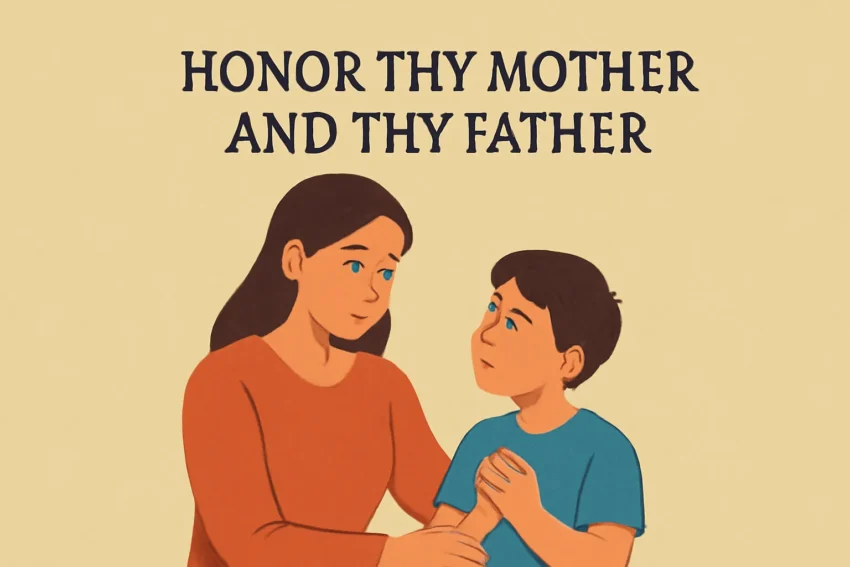
The Bible’s command to honor thy father and thy mother appears in the New Testament as Ephesians 6:2, where the apostle Paul repeats a timeless ethical expectation that stretches back to the oldest biblical texts. This article explores the verse itself, its biblical roots, its cultural context, and its relevance for modern readers. We will consider variations in translation, the difference between honor and obedience, and practical applications for families today. The phrase is universally familiar, yet its depth often becomes clearer when we see how it fits into the broader arc of Scripture and church life.
Context in Ephesians: Honor and Authority in the Household
The letter to the Ephesians places family relationships within a larger theological frame: the reconciliation and unity achieved through Christ should shape daily living. In Ephesians 6, Paul addresses both children and parents as well as bond-servants and masters. The immediate verses before and after Ephesians 6:2 help us understand how honor functions in a living faith:
Ephesians 6:1 commands children: “Children, obey your parents in the Lord, for this is right.”
Ephesians 6:2 follows with the explicit command: “Honor thy father and mother.”
In the Lord appears again in 6:1, suggesting that obedience and honor are shaped by faith and the Christian community’s values.
The passage sits within a broader ethic of mutual responsibility within the household: husbands and wives are called to love and submit in specific ways (Ephesians 5), while children and servants are called to respond to authority with honor and diligence. The aim is not merely compliance but the cultivation of a community where authority is exercised in a way that reflects Christ’s love and order.
Old Testament Roots: The Command to Honor Parents
To understand Paul’s exhortation in Ephesians, it helps to trace the roots back to the Old Testament, where the command to honor father and mother sits near the core of the moral law.
The Command in Exodus
The foundational text is Exodus 20:12, part of the Decalogue, which proclaims: “Honor thy father and thy mother: and thou shaltlive long in the landwhich the LORD thy God giveth thee.” This brief line ties family honor to social stability and the welfare of the whole community. The promise of long life in the land is not merely a personal blessing; it is a covenantal sign that honoring one’s parents contributes to the covenant people’s flourishing in a promised land.
The Command in Deuteronomy
Deuteronomy 5:16 echoes the Exodus command, sometimes with subtle emphasis on continuity and moral education: “Honor thy father and thy mother, as the LORD thy God hath commanded thee.” The repetition underscores that honoring one’s parents is part of a larger fidelity to God’s law, an instruction that the subsequent generations must carry forward.
Together, these OT texts frame honor not merely as regard for elders but as alignment with God’s order for family life and for society. When Paul cites this command in the New Testament, he is aligning Christian ethics with a long-standing biblical anthropology: the family is a schoolroom for virtues that bear on justice, mercy, and communal well-being.
The verb honor in the biblical sense carries several facets. In everyday speech, “honor” might imply respect, reverence, or deference. In Scripture, honored relationships involve a combination of respect, care, gratitude, and appropriate boundaries. Below are some dimensions of honor as it appears in biblical teaching and pastoral reflection.
Dimensions of Honor
Respect and deference in speech and attitude toward parents, recognizing their authority and experience.
Care and support for aging parents, including practical assistance, time, and resources when needed.
Gratitude for parental sacrifice, guidance, and nurture, which forms a posture of humility before God.
Listening and learning from parental wisdom and family history, recognizing that lived experience can still speak truth.
Boundary and discernment when parental expectations conflict with conscience or the gospel, exercised with humility and prudence.
It is essential to distinguish honor from obedience. While obedience is a specific behavioral stance often expected of children in the frame of parental authority, honor is broader and enduring. A person might choose to honor a parent even when they cannot or should not obey in a given situation, especially as one becomes an adult or when moral or safety concerns arise.
Honor Across the Lifespan
The command spans ages and circumstances. For young children, honoring may look like listening to guidance, reflecting gratitude, and obeying in the Lord’s framework. For adult children, honor often translates into ongoing care, respectful dialogue, and acknowledging the parental role in shaping one’s identity. For aging parents, honor can include practical support, emotional presence, and preserving family memories for the next generation.
Translations and Semantic Variations
Across Bible translations, the core command remains, but the wording shifts enough to affect nuance. The most familiar wording is the KJV (King James Version): “Honour thy father and thy mother: which is the first commandment with promise.” Other translations render the verse with subtle differences that influence interpretation and emphasis.
Key Translation Variants
KJV: “Honour thy father and thy mother: which is the first commandment with promise.”
NIV: “Honor your father and your mother”—which is the first commandment with a promise.
ESV and NRSV: “Honor your father and your mother: this is the first commandment with a promise.”
NASB: similar to formal translations, emphasizing fidelity to the text with “this is the first commandment with a promise.”
The phrase “with a promise” is a central theological element. In biblical terms, a “promise” attached to a command is an assurance that obedience aligns with God’s will and yields a blessing. The promise attached to this command is typically understood in two dimensions: personal well-being and societal stability in the land God gives to his people.
Some modern readers extend the breadth of “honor” to include respect for parental authority within families that cross cultural boundaries, while others stress that the command is rooted in God’s design for family order as an arena of moral formation. In all cases, the translations preserve the call to honor as enduring, not merely situational or ceremonial.
A recurring question concerns how honor relates to obedience. In Ephesians 6:1, Paul says, “Children, obey your parents in the Lord, for this is right.” This makes clear that obedience is an expectation for the younger generation, particularly as a matter of moral formation and alignment with God’s order.
By contrast, honor in verse 2 speaks to a deeper and more enduring posture that remains relevant beyond childhood and adolescence. It includes, but is not limited to, obedience. It encompasses respect, gratitude, support, and fidelity to the parental role, even in situations where one’s choices as an adult may diverge from a parent’s preferences. This distinction helps believers navigate conflicts within families without erasing the dignity and value of parental authority.
Practical Examples
When a parent speaks with wisdom from experience, an adult child may choose to listen attentively and consider the counsel, thereby honoring the parent.
During times of disagreement, an individual can maintain respect and engage in constructive dialogue while pursuing what is ethically safe and faithful to their conscience.
In caregiving situations, honoring may involve practical support, companionship, and ensuring the parent’s dignity and well-being.
Historical and Theological Significance in the New Testament
Paul’s reiteration of the command is not an isolated moral instruction; it resonates with a broader theological aim in Ephesians. The early Christian communities were navigating the intersection of newly forming church authority, family obligations, and the social realities of Roman-adjacent households. The call to honor parents aligns with Jesus’ teaching about the authority of family and the ethics of love, humility, and service.
Relation to Household Codes
Ephesians 5–6 contains what many scholars call “the household codes.” These codes offer a framework for mutual submission within family life: husbands are to love their wives as Christ loves the church; wives are to respect their husbands; children and servants are to obey and honor. The effect is not to subjugate but to guide relationships toward the common good and the witness of the gospel.
In this scheme, honor thy father and thy mother functions as a foundational principle, one that crosses generations and power dynamics. It signals a recognition that family life is a divine institution meant to shape character, cultivate virtue, and reflect God’s order in creation.
Applications for Modern Readers
How should contemporary believers apply Ephesians 6:2 in everyday life? Here are several practical directions that honor the biblical intent while addressing today’s realities.
Respect and communication: Build a pattern of respectful communication with parents, showing patience, listening well, and offering thoughtful responses rather than reactive rebukes.
Care for aging parents: When possible, provide physical, emotional, and financial support that preserves their dignity and safety. This is a concrete form of honoring the parental role.
Gratitude and remembrance: Express gratitude for the sacrifices and lessons received. Celebrate family memories and share stories that honor parents’ contributions to one’s life.
Boundaries with wisdom: Honor does not require tolerating abuse or compromising safety. Boundaries can exist within a framework of respect and care for all involved.
Intergenerational faith formation: Teach younger generations about the values of honoring parents as part of a life of faith that honors God’s design for family and community.
Beyond individual families, the principle of honoring parents intersects with community ethics: elders deserve dignity, societies benefit when older members are cared for, and the integrity of intergenerational relationships strengthens communal life.
Common Questions and Clarifications
As readers wrestle with this verse, several questions frequently arise. Here are concise answers framed by biblical interpretation and pastoral care.
Q: What if my parents are abusive or harmful to me?
In such cases, honor should not require remaining in danger. The Bible calls us to seek safety, protect the vulnerable, and pursue reconciliation when possible and wise. In many situations, care for one’s own safety and the safety of others must take precedence, while still maintaining a posture of respect and compassion toward parents.
Q: Does honor imply blind obedience for adults?
Not at all. Honor remains a posture of respect and fidelity, even when an adult disagrees with a parent. The New Testament allows for discernment and prudent decision-making, especially when moral or ethical concerns arise. The aim is to uphold the dignity of the parental role while honoring God above all.
Q: How does this verse relate to modern parenting and family life?
The verse is often used to affirm the importance of family ties, mutual care, and the reciprocal obligations of children toward parents. Modern parenting can reflect the timeless principle by fostering environments of safety, respect, mentorship, and honor that value the wisdom and sacrifices of older generations.
Q: Is this command universal for all cultures?
The biblical command sits within a Jewish and early Christian context but has found resonance across many cultures that honor parents. While cultural expressions of honor may vary, the core idea of recognizing the parental role and showing gratitude remains meaningful across traditions.
Conclusion: The Enduring Significance of Ephesians 6:2
Ephesians 6:2—“Honor thy father and thy mother: which is the first commandment with promise”—encapsulates a principle that has shaped personal conduct and social life for centuries. The verse links domestic obedience and family respect to God’s larger purposes for creation and community. Through its OT roots in Exodus and Deuteronomy, its NT expression in Paul’s household codes, and its ongoing relevance for today’s families, the command to honor parents invites believers to cultivate a posture of reverence, care, and gratitude that honors both the human family and the God who ordained it.
As readers continue to study and apply this passage, they may discover that honor is less about rigid rule-keeping and more about a faithful way of living that honors the God who created family as a stage for spiritual formation. Whether one is addressing a young child, a teenager navigating adolescence, or an adult caring for aging parents, the call remains: to live with honor, to extend respect, and to sustain the bonds that reveal God’s love working through generations.