Demons Scripture: A Comprehensive Guide to Biblical Passages and Interpretations
Across the biblical canon, references to demon (and its variations) appear in varied genres—from historical narrative to prophetic apocalyptic writing. This article provides a thorough, accessible survey of demons scripture in both the Old and New Testaments, clarifying language, contexts, and interpretive approaches. The aim is not only to catalog passages but to illuminate how scholars, pastors, and lay readers understand demonic forces within the broader story of God, humanity, and salvation history.
What Demons Scripture Means: Key Concepts and Terminology
When biblical writers speak of demon(s), they are engaging a range of ideas about spiritual beings, influence, and power. In many English translations, the same Greek and Hebrew terms are rendered in multiple ways, including daemon, demon, unclean spirit, and evil spirit. Readers should pay attention to the linguistic pedigree of each term and the context in which it appears.
Daimôn/daimonion (Greek): The technical term in the Greek New Testament for a demon, a spiritual being that opposes God and can exert influence or control over human beings.
Unclean spirit / evil spirit (New Testament): Descriptive phrases used to convey a kind of spiritual influence associated with uncleanliness in ritual and moral life.
Beelzebul (also Beelzebub): A title for a leading demon, often invoked in polemics about the source of demonic power (notably in Jesus’ exchanges in the Gospels).
Satan: A figure who functions as accuser, tester, and adversary; in some texts he directs or permits malevolent work, while in others he is the adversarial force behind opposing God’s purposes.
Legion: A symbolic or literal name for a multitude of demons who spoke through one afflicted person in Mark 5 and Luke 8.
Beings of the heavenly realm vs demons: The Bible distinguishes between angelic powers, principalities, and the more malevolent demonic entities that oppose God’s rule.
In all cases, biblical demonology is best understood against a framework of cosmic conflict: God’s sovereignty over creation, and the existence of spiritual forces that tempt, oppress, or mislead human beings. This guide will explore passages that anchor these ideas in concrete stories, while also noting the interpretive questions scholars raise about genre, history, and theology.
Demons in the Old Testament: References, Context, and Meaning
The Old Testament contains fewer explicit narratives about demons than the New Testament, but it does present a coherent set of ideas about spiritual powers that can afflict or abet human brokenness. The Hebrew terms shedim (often translated demon(s)) and other phrases signal a world in which spiritual beings influence people, nations, and religious practice. The following passages are central to understanding old testament demonology in its own terms.
Representative Old Testament Passages
1 Samuel 16:14—“An evil spirit from the Lord tormented Saul.” This phrase has generated rich debate about whether the source is punitive, pedagogical, or a literary way of describing oppressive inner turmoil. The verse foregrounds the idea that spiritual influences can affect a person’s mood, judgment, and leadership.
Deuteronomy 32:17—“They sacrificed to demons,” which in context expresses rebellion against the God of Israel and participation in cultic practices associated with hostile spiritual powers.
Psalm 106:37—“They sacrificed their sons and their daughters to the demons” (shedim). This lament connects idolatry with contact with malign spiritual forces and serves as a warning about the danger of alternative loyalties.
Leviticus 17:7 and related passages—Prohibitions on offering sacrifices to other beings, implying a boundary between worship of the true God and demonic-adjacent practices.
Additional later texts in the Hebrew Bible’s intertestamental milieu reflect ongoing Jewish reflections about spiritual powers, angelic beings, and the presence of hostile forces in the world, which later writers in the Second Temple period would expand upon in nuanced ways.
In the Old Testament, the concept of demons often appears in a negative frame—idolatry and pagan practices tied to hostile spiritual powers. Yet the biblical authors consistently affirm God’s sovereignty over all creation and the ultimate superiority of God’s power, even when spiritual forces play a distressing role in human affairs.
Demons in the New Testament: Jesus, Exorcisms, and Early Christian Exegesis
In the New Testament, demons scripture becomes a central motif in the life and ministry of Jesus and in the early Christian communities. The Gospels narrate a series of dramatic encounters in which demon-possessed individuals are freed by Jesus’ authority. These accounts function on multiple levels: they prove Jesus’ identity and authority, reveal the nature of the kingdom of God, and offer a model for how communities should respond to spiritual oppression.
Key New Testament Passages and Themes
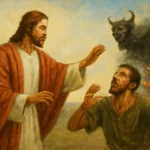
Mark 1:23-26—Jesus commands an unclean spirit to depart from a man in a synagogue, demonstrating sovereign authority over demonic powers.
Mark 5:1-20 (and parallel accounts in Luke 8:26-39; Matthew 8:28-34)—The healing of the man possessed by a legion of demons reveals a dramatic transformation of a person’s life and a relocation of the demon’s power. The name Legion signals a multitude and emphasizes the gravity of spiritual bondage and liberation.
Luke 4:33-36—In Capernaum, Jesus confronts a demon-possessed man in which the demon declares Jesus’ identity, and Jesus rebukes the spirit, restoring peace to the scene.
Matthew 12:22-29—Beelzebul discourse: Jesus’ opponents accuse him of casting out demons by the power of Beelzebul, prompting a calculation about the nature of the kingdom and the source of power they attribute to him.
1 Timothy 4:1—“Some will depart from the faith and pay heed to deceitful spirits and teachings of demons,” indicating a broader, ongoing risk of demonic influence within early Christian teaching and practice.
James 2:19 (often connected with demonology in Jewish-Christian thought): the claim that even demons “believe” in God, yet tremble, underscoring a distinction between belief and obedience.
Acts 16:16-18—A slave girl with a spirit of divination is freed by Paul’s command, illustrating how the apostolic ministry disarms occult power in concrete settings.
Ephesians 6:12—A formative text for Christian spiritual warfare: “our struggle is not against flesh and blood, but against the rulers, against the authorities, against the cosmic powers over this present darkness.”
Revelation 9:11—The abyss contains a king whose name in Hebrew is Abaddon, and in Greek Apollyon; this figure functions within the apocalyptic vision of demonic forces seeking to oppose God’s purposes in the last days.
These passages collectively present a robust picture of demonic activity in the New Testament era: Jesus exercises authority, the apostles confront demonic powers, and early Christian writers interpret these events within a broader theological frame of victory, mercy, and moral responsibility.
The Language of Demons: Key Terms and How to Read Them
Reading demons scripture involves careful attention to language, genre, and audience. Below are some essential terms and ideas encountered across biblical texts.
Daimôn/d aimonion—The primary Greek word for demon in the New Testament; it designates a spiritual being opposed to God.
Unclean spirit / evil spirit—Descriptive phrases used to describe moral and ritual impurity associated with demonic influence.
Satan—A figure who tests, tempts, and opposes human beings and God’s purposes; in some contexts he appears as the orchestrator of demonic activity, in others as a prosecuting adversary within the divine plan.
Beelzebul—A title for the prince of demons, invoked in polemics about the source of Jesus’ power and the nature of the Kingdom of God.
Legion—A name that communicates both a multiplicity of demonic beings and the depth of the siege they waged against the governed person.
Pneuma/daimonion—The Greek terms for spirit or demon, used in various ways across the New Testament to describe both divine and malevolent spiritual realities.
Grasping these terms helps readers distinguish between literal exorcisms performed by Jesus and the broader, metaphorical language some passages use about spiritual power and moral influence.
Theological Frameworks: How Scholars Read Demons Scripture
Across Christian traditions, several interpretive frameworks shape how demons scripture is understood. Each approach emphasizes different aspects of the biblical text and its message for faith and practice.
Literal interpretation treats demonic possession and exorcism as real, historical events that occurred within the physical world of first-century Palestine and the early Christian communities.
Symbolic interpretation reads demonic figures and possession imagery as metaphorical language expressing inner conflict, social oppression, or spiritual realities that are not purely empirical.
Many scholars adopt a nuanced stance, recognizing historical particulars while acknowledging that some language is intentionally vivid and emblematic, aiming to convey truth beyond mere facts.
Historical-Critical and Contextual Readings
Exegesis considers the cultural and religious world of Second Temple Judaism and Greco-Roman practices. Exorcism, for example, occurs within a context where itinerant exorcists, magic, and healing cults existed, and where healing often included spiritual dimensions.
Textual comparisons across the Gospels highlight how different writers frame the same events to emphasize various theological concerns—Jesus’ authority, the nature of the Kingdom of God, and the integrity of the new faith community.
Pastoral and Doctrinal Implications
Many readers weigh spiritual warfare as a real dimension of Christian life, yet maintain care to avoid sensationalism or demonizing everyday experiences such as illness or mental distress.
Pastors and teachers often use demonology sensitively to address fear, discernment, and community healing, especially when guiding people through distressing experiences that may have multiple sources—psychological, social, and spiritual.
From Exorcism to Spiritual Warfare: Practical Distinctions in the Bible
Clear distinctions emerge in Scripture between individual cases of possession, oppression, and broader spiritual influence. Recognizing these distinctions helps modern readers avoid conflating phenomena that require different kinds of response.
Possession: An individual is thought to be under the control or influence of a demon to the point of visible behavioral manifestations. The canonical gospel accounts of exorcism depict an authoritative act of release by Christ.
Oppression: A more ambiguous or persistent pressure exerted by demonic forces, often experienced as fear, anxiety, or persistent temptation rather than direct possession.
Influence or temptation: The broader cultural and spiritual environment can be described as influenced by hostile powers, especially in passages like Ephesians 6:12 and 1 Timothy 4:1.
Modern readers may encounter situations that shape these distinctions differently, but the biblical pattern emphasizes discernment, compassion, and the primacy of Christ’s authority as the decisive factor in deliverance and healing.
How to Study Demons in the Bible: A Practical Guide
Studying demons scripture responsibly requires method, humility, and a willingness to engage multiple voices. Here is a practical approach for readers, students, and educators alike.
Read in context: Examine the surrounding narrative, genre (gospel, wisdom literature, prophetic writing, epistle), and audience to understand why the text presents demonic power in a particular way.
Compare gospel accounts: When a miracle or exorcism is reported in more than one Gospel, compare details to appreciate how each author emphasizes different theological themes.
Note original languages: Pay attention to Hebrew terms (shedim) and Greek terms (daimonion) to discern nuances that translation may obscure.
Consult a range of commentaries: Specialist resources can illuminate historical context, linguistic choices, and theological implications.
Differentiate sources of authority: Distinguish what the text says about demonic power from what it prescribes for contemporary faith and practice.
Mind the translation differences: Some English translations render the same term differently; cross-check parallel passages in multiple versions.
Integrate with other biblical themes: Situate demonic references within broader doctrines—creation, fall, redemption, sanctification, and ultimate victory in Christ.
Misconceptions and Clarifications about Demons Scripture
Wisely navigating demons scripture means addressing common misunderstandings without diminishing the seriousness of spiritual realities. Here are several important cautions and clarifications:
Not every mental health issue is demonic possession. Biblical texts that speak of possession often describe extreme cases and should not be generalized to every instance of fear, anxiety, or mood disorder.
Exorcism is not the only form of deliverance. The New Testament portrays healing, restoration, teaching, and spiritual formation as central to Jesus’ mission and the church’s life, not only the eradication of demonic presence.
Possession is not ubiquitous. The New Testament does not present possession as a universal experience; rather, it highlights specific dramatic incidents that illustrate larger truths about Jesus’ authority and the nature of the kingdom.
Spiritual warfare is about allegiance. The language of spiritual struggle emphasizes loyalty to God, truth, and righteousness rather than sensational struggles with fearsome entities alone.
Implications for Modern Readers: Faith, Discernment, and Compassion
Though demons scripture belongs to a different era and context, it carries meaningful implications for contemporary faith communities. Here are some practical takeaways that scholars and pastors often highlight.
Discernment and pastoral care: Guidance in recognizing distressing experiences, distinguishing spiritual oppression from mental health concerns, and offering compassionate care remains essential.
Prayer and spiritual discipline: The biblical call to prayer, worship, and resisting temptation continues to be a central theme in the life of believers facing spiritual struggle.
Exorcism as a historical motif: In most modern contexts, the term “deliverance” is used to describe interventions aimed at healing, restoration, and the reaffirmation of one’s identity in Christ, not only a dramatic confrontation with demonic entities.
Ecumenical humility: Different Christian traditions emphasize varied practices of discernment, healing, and exorcism, all within a shared faith in God’s sovereignty and Christ’s victory.
Glossary of Key Terms
Demon
A spiritual being opposed to God, often described as malevolent or deceptive, capable of influencing or oppressing humans in various ways.
Unclean Spirit / Evil Spirit
Terms used in biblical texts to describe demonic forces or influences associated with ritual impurity, moral disorder, or spiritual oppression.
Daimôn / Daimonion
Greek words for “demon” or a demon-entity in the New Testament; used to denote personal beings as well as a class of powers opposing God.
Beelzebul
A title for the prince of demons, often used in polemical exchanges about the source of Jesus’ power.
Legion
A name for a group of demons and, symbolically, a great number of malevolent beings
Satan
The adversary figure who opposes God’s purposes and can act as accuser, tester, or deceiver within biblical narratives.
Exorcism
The act of commanding demonic or malevolent powers to depart, as depicted in several gospel accounts.
Spiritual warfare
A language and practice of resisting evil and standing firm in faith, often articulated in Ephesians 6:10-18 and related passages.
Sheer (shedim)
The Hebrew term used in some Old Testament passages to refer to demons or hostile spiritual powers.
For readers who want to explore demons scripture in greater depth, a mix of scholarly and accessible resources can be helpful. Consider the following avenues:
Bible dictionaries and encyclopedias that cover demonic literature and terms in both Hebrew and Greek, such as entries on shedim and daimonion.
Gospel parallel studies that compare accounts of exorcism across Matthew, Mark, Luke, and John to illuminate differences in emphasis and purpose.
Commentaries on Pauline letters (e.g., Ephesians, Colossians, 1 Timothy) that address “the powers and authorities” and the language of spiritual warfare in the earliest churches.
Introductory overviews of Second Temple Judaism and early Christian demonology to understand the cultural milieu of New Testament writings.
Trusted online resources and audio-visual studies from reputable Bible study organizations and scholarship programs that explain terms like daimonion and the historical context of exorcism.
When engaging these resources, maintain a careful balance between historical-critical insight and pastoral concern. The goal of studying demons scripture is not sensational curiosity but a hope-filled interpretation that honors the text, fosters spiritual discernment, and invites readers into the robust life of faith centered in God’s redemptive work through Christ.
Conclusion: A Comprehensive View of Demons Scripture
From the Old Testament warnings against cultic practices that opened doors to hostile spiritual powers, to the New Testament portrait of Jesus as King who defeats, commands, and dispels demonic influence, the biblical witness to demonic powers is both vivid and purposeful. It speaks to the reality that humans live within a layered order of reality where spiritual forces contend with divine purposes. Yet the through-line of scripture remains clear: God is sovereign, Christ is supreme, and the believer is called to trust, resist evil, and walk in the light of truth. By approaching demons scripture with careful exegesis, pastoral sensitivity, and theological clarity, readers can gain a fuller understanding of how the Bible presents the problem of evil and the gracious, transformative solution offered in the gospel.