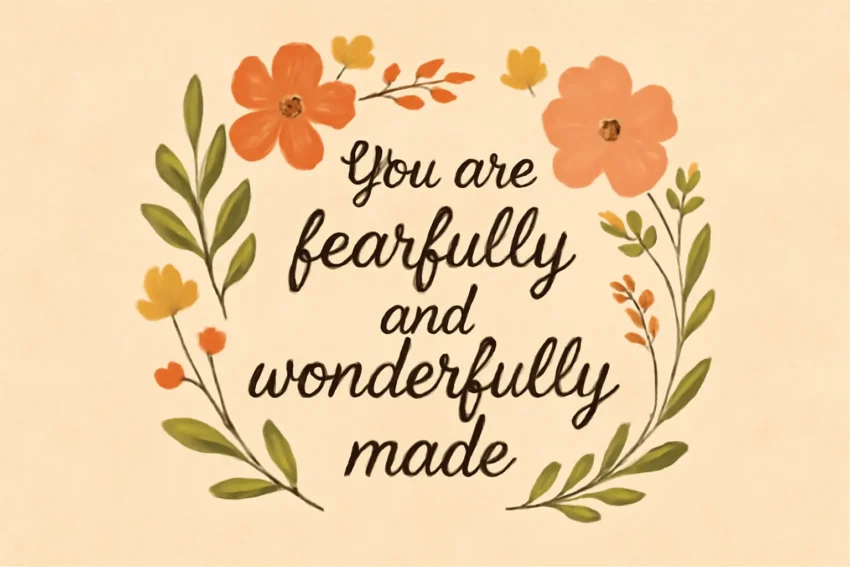
The phrase “You are fearfully and wonderfully made” has echoed through generations as a core reminder of human value. In Psalm 139:14, the Psalmist declares a response of praise upon recognizing the divine craftsmanship behind every person. This article explores the breadth and depth of that verse, offering historical context, linguistic considerations, theological implications, and practical ways to live out the truth that each person is an intentional, precious creation. We will consider variations of the verse across translations, how this message intersects with contemporary life, and how individuals, families, schools, and communities can use this insight to cultivate dignity, hope, and responsibility.
In many faith communities, this single verse becomes a touchstone for conversations about self-worth, purpose, and belonging. It is not merely a static statement about beauty; it is a doorway into conversations about identity in relationship to the Creator, the community, and the wider world. Below, you will find a structured exploration that moves from the literary and historical backdrop to practical applications in daily living.
Context and Meaning in Psalm 139
Psalm 139 is a psalm of intimate divine knowledge and presence. It speaks of God’s all-seeing, all-knowing nature—an image of a God who searches, accompanies, and sustains. The line in focus—often translated in various ways as belonging to this gift of self-understanding—functions as a climactic moment within the prayer of the psalmist. The immediate wording in the classic King James Version (KJV) is, in part: “I will praise thee; for I am fearfully and wonderfully made: marvellous are thy works; and that my soul knoweth right well.” Even as modern readers encounter different English renderings, the core message remains: the Creator’s design is worthy of praise, and human beings can know, with confidence, that they are a product of deliberate, intricate design.
The intention behind this verse is twofold. First, it honors God as the author of life and creation. Second, it affirms the receiver’s intimate, personal worth within that creation. The phrase “fearfully and wonderfully made” evokes awe (fear) and meticulous care (wonderfully made). It invites readers to contemplate the dignity embedded in physical form, mental capacity, emotional depth, and spiritual potential. It is not a statement about perfection; rather, it is a declaration about purposeful design, vulnerability, and the goodness of being alive under a Creator who knows us completely.
Across centuries, theologians have highlighted that this verse is not a private compliment alone but an invitation to relational trust. If you are fearfully made, you are held in the vastness of God’s knowledge and providence. If you are wonderfully made, you reflect the artistry, intention, and wisdom of the Creator. These terms work together to nurture humility, gratitude, and responsibility: humility before the mystery of life, gratitude for the gift of existence, and responsibility to steward one’s gifts and toward others with care.
For readers today, one practical takeaway is that identity begins not with comparison or external approval but with a secure sense that you are known, valued, and formed with purpose by the divine craftsman. This perspective has implications for how we approach education, relationships, mental health, and vocation—areas where a sense of meaning can make a decisive difference.
Variations Across Translations: Semantic Breadth and Nuance
Translators render ancient Hebrew poetry into contemporary English with varying degrees of emphasis. The core claim remains consistent, but the wording can shift emphasis, cadence, and nuance. Below are representative renderings from several widely read translations to illustrate how the same verse can be expressed with slightly different facets of meaning.
King James Version (KJV) emphasizes both the act of praise and the paired descriptions “I will praise thee; for I am fearfully and wonderfully made.” This classic phrasing stresses worship as the natural response to being created with care.
New International Version (NIV) shifts toward a more direct personal assertion: “I praise you because I am fearfully and wonderfully made; your works are wonderful, I know that full well.” The emphasis here is on knowledge and confidence in the maker’s works.
English Standard Version (ESV) presents a succinct, contemporary beat: “I praise you, for I am fearfully and wonderfully made.” This rendering foregrounds gratitude in a concise clause.
New Revised Standard Version (NRSV) offers a balanced approach with a slightly more formal tone: “I praise you, for I am fearfully and wonderfully made; wonderful are your works.”
New American Standard Bible (NASB) preserves a careful, nearly literal sense: “I will give thanks to You, for I am fearfully and wonderfully made; Wonderful are Your works.”
Beyond these major English translations, there are paraphrase editions and study Bibles that present the verse with modern language or devotional framing. Regardless of the exact rendering, the recurring ideas are clear:
Praise and gratitude in response to the divine act of creation.
Recognition of intentional design rather than random chance.
Assurance of value grounded in God’s works and character.
When engaging with translations, readers can benefit from comparing a few versions side by side. This practice helps reveal the range of nuance—how a single phrase can carry implications about knowledge, wonder, purpose, and relationship. It also invites readers to consider the interpretive choices that accompany translation, a reminder that the Bible, while rooted in ancient languages, remains a living text that speaks differently to each generation.
Why translation choices matter
The way a verse is translated can shape emphasis in teaching, preaching, and personal devotion. For example:
Some renderings foreground grateful praise as the immediate response to God’s creation.
Others foreground a sense of assurance of value inherent in the act of being made.
Still others highlight the interplay between God’s works and the believer’s interior knowledge or conviction.
Theological Significance: Imago Dei, Identity, and Worth
The conviction that each person is “fearfully and wonderfully made” resonates deeply with the biblical concept of the Imago Dei—the belief that humans bear the image of God. Though the phrasing of Psalm 139:14 differs from the Genesis creation account, the theological throughline is consistent: human beings are not incidental; they are bearers of divine imprint, endowed with dignity, purpose, and relational potential.
This view has several important dimensions:
Dignity rooted in design rather than achievement or appearance.
Purpose tied to being known by God and called to stewardship and love toward neighbor.
Inclusivity in that every person carries the same fundamental value, regardless of circumstance.
The phrase also invites believers to consider how their communities reflect the Imago Dei. Do institutions—schools, workplaces, churches, and families—affirm that every person is valuable, deserving of protection, care, and opportunities to flourish? When communities enact this truth, the verse moves from personal affirmation to social ethic: a call to justice, compassion, and hospitality.
Practical Applications: Living as People Who Are Made with Purpose
The intellectual and theological grasp of Psalm 139:14 becomes meaningful when it’s translated into daily habits, attitudes, and choices. The following practical applications aim to turn belief into behavior.
Self-understanding: Begin with self-reflection that recognizes your unique design. Keep a journal entry noting areas of strength, areas for growth, and experiences that reveal your God-given capacities.
Relationships: Approach others—with the assumption that they, too, are fearfully and wonderfully made—with respect, patience, and a readiness to forgive. This stance can transform how families, friendships, and workplaces interact.
Mental and emotional health: Integrate the verse into routines of care. For example, during times of anxiety or self-doubt, recite the phrase and pair it with grounding practices that emphasize safety, presence, and belonging.
vocation and education: Encourage explorations of gifts, talents, and callings as parts of a larger, purposeful design. This perspective can relieve pressure to conform to external standards and instead honor personal fit and meaningful contribution.
Compassion and service: Recognize the value of peers who may feel marginalized. A community that affirms the truth of being made with care is more likely to extend welcome, support, and advocacy.
Write a short paragraph describing what being fearfully and wonderfully made means for your sense of self-worth today.
List three areas where you see God’s workmanship reflected in your life—physical health, talents, and relationships.
Record one moment when you perceived care and intention in your own formation. How did that awareness shape your actions that day?
Create a one-minute prayer of gratitude acknowledging God as the artist who formed you with purpose.
Historical and Literary Context: Poetry, Praise, and Personal Address
The Psalmist speaks in the voice of someone who experiences God as intimately present—a guide who knows the number of hairs on the head and the innermost thoughts of the heart. Psalm 139 blends sections of awe at divine knowledge, gratitude for creation, and a plea for divine protection and guidance. The moment of declaring being “fearfully and wonderfully made” sits within a larger mosaic of spiritual devotion: an angle of approach that does not separate metaphysical contemplation from practical living.
In many faith traditions, that integration—mind, body, and spirit—matters a great deal. It affirms that a person’s inner life and outward appearance are not incongruent with a sacred origin. The verse invites believers to consider how their inner convictions align with outward actions: how thoughts, words, and deeds reflect the truth of their formation.
Editorial note on historical reception
The reception of Psalm 139:14 has varied across times and communities. In some eras, it has been a source of critique against harmful social hierarchies by insisting on intrinsic worth for all people. In other contexts, the verse has been used to provoke personal introspection and humility—recognizing that true self-worth comes from being crafted by a generous Creator, not from human standards. The common thread is the recognition that identity is not a task to be earned but a gift to be received with gratitude and responsibility.
Common Misunderstandings and Healthy Boundaries
Like any powerful verse, Psalm 139:14 can be misunderstood if read in isolation from the broader biblical narrative or from community life. Some common misunderstandings include:
That human value is tied solely to physical appearance. The message goes beyond appearance; it concerns the totality of being formed with intention by a loving Creator.
That worth excuses harm. Recognizing intrinsic value must be paired with accountability, humility, and love for neighbor, especially those who are vulnerable.
That flaws disprove God’s craftsmanship. The verse speaks to the inherent value of a person as the product of divine design, even while acknowledging brokenness and the need for healing.
A balanced reading invites a compassionate, truthful approach to life: we accept the truth of worth while acknowledging the realities of brokenness, sin, and the ongoing work of transformation. In faith communities, this often translates to pastoral care, ethical conduct, and practical acts of mercy that honor the Creator’s workmanship.
Applications in Education, Family, and Community Life
The conviction that each person is fearfully and wonderfully made offers a robust framework for education, parenting, and community development. Here are several domains where the verse can inform practice.
In schools: curricula and classrooms that affirm diverse gifts, encourage curiosity, and respect individual differences. Programs that emphasize growth mindset, inclusion, and student-led learning align with the sense that every learner is prized as purposeful creation.
In families: parenting strategies that balance discipline with empathy, emphasizing a child’s unique design and potential. Family conversations can center on gratitude for each member’s contributions and on the importance of nurturing each other’s gifts.
In communities: social initiatives that focus on the dignity of every person—older adults, disabled individuals, new immigrants, and others who might experience marginalization. The verse can underpin advocacy for civil rights, healthcare, education, and equitable opportunity.
Engaging with this verse across these contexts encourages a habit of prayerful discernment: asking how best to honor the divine artistry in ourselves and in one another, and how to use one’s abilities to serve the common good.
The truth of being fearfully and wonderfully made has inspired artists and writers to articulate gratitude, wonder, and responsibility. Creative works across genres have used this theme to explore identity, resilience, and belonging. Music often translates the verse into melodies of praise, while visual arts may depict the human form with delicate detail or luminous symbolism. Literature can frame personal narratives that trace a path from doubt to assurance, from isolation to connectedness.
For educators and communicators, incorporating creative expressions of this message can deepen engagement. For example:
Student-led art exhibits that celebrate diverse forms of beauty and ability.
Music projects that set texts about worth and formation to original compositions.
Reading groups where participants share personal stories of discovering their identity within a faith community.
Study Toolkit: Methods for Deepening Understanding
If you want to study Psalm 139:14 more deeply, here are practical tools that can be adopted individually or in small groups. The aim is to cultivate a robust, lived understanding of being fearfully and wonderfully made that translates to action.
Verse comparison: Create a side-by-side chart of 4-6 translations. Note phrases that shift emphasis and discuss why those shifts might matter in a devotional or teaching context.
Context mapping: Read Psalm 139 as a whole. Mark verses that describe God’s attributes (omniscience, omnipresence, sovereign care) and verses that speak to the human response (praise, trust, worship).
Language note: If possible, consult a concordance or lexicon to discuss the idea of “fearfully” (a strong, reverent awe) and “wonderfully” (distinct, marvelous craftsmanship) without overdefining the terms.
Personal reflection: Maintain a weekly journal entry focusing on one facet of being made in God’s image—intellect, creativity, relationships, or physical health—and how that facet informs your choices.
The phrase conveys awe and reverence. It suggests that humans are created with intentional care that inspires humility before the Creator and respect for the gift of life. It is not a command to fear in a negative sense, but a recognition that God’s power and wisdom are immense, and we are the product of thoughtful design.
How does this verse relate to self-worth?
It affirms intrinsic value—not tied to achievement, appearance, or status. The worth of a person is rooted in being crafted by God, who knows each person intimately and loves them. This makes self-worth a stable reality that can withstand changing opinions and life circumstances.
Can this verse apply to others who may feel devalued?
Yes. If all people are fearfully and wonderfully made, then communities are called to uphold the dignity of every member. This has ethical implications—promoting inclusion, housing, healthcare, education, and justice for marginalized groups.
How can we practically teach children to embrace this truth?
Through language that is affirmative and age-appropriate, consistent messages about worth, and opportunities for children to contribute meaningfully to family and community life. Activities that celebrate diverse gifts—art, science, sports, music, caregiving—can nurture a sense that every person’s design has value.
Conclusion: A Lifelong Theme of Trust, Gratitude, and Purpose
The declaration that each person is fearfully and wonderfully made invites a lifelong journey of trust in the Creator, gratitude for the gift of life, and responsibility to steward one’s gifts for good. It is a statement that holds both intimate personal meaning and expansive social energy: it comforts the afflicted, emboldens the humble, and challenges communities to honor the dignity of every human being.
Whether encountered in quiet devotion, classroom discussion, pastoral counseling, or a family dinner table, this verse can function as a guiding refrain: to praise, to affirm, to care, and to act with integrity. In a world full of noise and comparison, the truth that we are made with care and made for relationship can be a steady compass, pointing toward wholeness, hope, and a future shaped by love.